Showing posts with label Jim Broadbent. Show all posts

Thursday, May 29, 2014

Review: "Filth"


Director: Jon S. Baird
Runtime: 97 minutes

Above all else, Filth is a testament to the range of Scottish actor James McAvoy. He first came to prominence as a sweet little faun in the first Narnia film, and has since played doomed lovers (Atonement) and superheroes (X-Men) with equal skill. Yet none of the actor's previous work will prepare you for what he pulls off in Jon S. Baird's adaptation of Trainspotting author Irvine Welsh's novel about police corruption. While it's (hopefully) far too early to call McAvoy's work the performance of his lifetime, it sure as hell sets the bar quite high. There is, sadly, a tradeoff. In order to see James McAvoy be so brilliant in Filth, you have to actually watch Filth the movie. 

Great performances surrounded by lackluster films are nothing new, to be sure. Just a few years ago, Javier Bardem delivered stunning work in Biutiful, which was otherwise a sluggish, empty drama. Yet maybe the boredom that came with Biutiful wasn't so bad after all. Filth likely won't leave you bored, but that's because it's trying so hard to be edgy and outrageous, when it's mostly just cruel and vile, even though it's not noticeably more graphic than similar films. 

Though not nearly as big in scope, Filth is something like a Scottish answer to last year's The Wolf of Wall Street. This time, however, the corrupt figure at the center is a policeman, rather than an investment banker. That policeman is Bruce Robertson (McAvoy, complete with oily hair and scuzzy ginger beard), who is desperate for a promotion. Said promotion, according to an oddly theatrical intro scene featuring his wife Carole (Shauna Macdonald), will help put the spark back in their marriage. The couple aren't exactly struggling, but they're in the midst of a ritualistic sex game of sorts, with Bruce's work life currently functioning as the playground. All Bruce has to do undermine his co-workers, at any cost, in order to make himself the clear choice for the job. 

Yet just as Bruce's boss spends more time thinking about movies than policework, you'll soon find part of your mind wandering elsewhere. Filth has a little bit of naughty fun with Bruce's inner monologue at the outset (particularly his views on the Scottish people), but it runs out of fun or interesting things to say not much later. This is the sort of cinematic provocation that walks a fine line between vivaciously portraying wicked behavior and actively condoning said behavior. Sophomore director Jon S. Baird generally avoids falling into the trap of supporting Robertson's commentary, which includes homophobia, misogyny, and buckets of crassness. 

Unfortunately, that doesn't mean that Filth gets away with having its dirty little cake and eating too. The plotting weaves murkily between exploring Bruce's vices and his undermining of his coworkers, without much of an arc really emerging. The career stuff really gets the short end of the stick, and what could play out as a set of wicked games is left to laziness (ex: Bruce writes homophobic graffiti in the office, assigns blame to someone else, looks noble...the end). 

The work subplot is ultimately just more fodder for the film to show Bruce's depravity. In fairness, Baird gets that across well enough, especially when he visualizes the inside of the character's head. But, despite a running time only half of The Wolf of Wall Street, Filth starts to flounder as it heads down the tar-black rabbit hole. The brunt of the film's psychology is withheld for the sporadically nightmarish final act, which feels lazy, rather than shocking. The ugly, blue-hued visuals certainly don't add anything to whatever atmosphere Baird and Co. were aiming for.

Literally the only worthwhile part of the enterprise is McAvoy, who is placed front and center throughout all of the muck and grime. Though the material is often frustrating, McAvoy takes the scant initial details and absolutely goes to town with it. Others would have drowned in the ugly quagmire at the film's core, but McAvoy smashes through it, making every naughty grin and sadistic freak out feel effortless. He'd send the rosy-cheeked heroes of Narnia (and maybe even a few of the monsters) fleeing for their bedrooms. Meanwhile, the rest of the talented supporting cast are left with little more to do than act oblivious, or fall prey to Bruce's spell.

Though the final act does introduce some compelling psychology to the bad-boy mayhem, it feels desperate, rather than earned. In the hands of someone like Martin McDonagh (In Bruges), a story like Filth could have been a brilliant, warped, and ultimatelty devastating look at mental illness and unchecked immorality. Instead, the mental illness piece of the puzzle is wielded as a blunt instrument in a last ditch effort to make Filth "about" something, even as it provides the viewer one last faux-edgy kick in the final frames. Inside Bruce Robertson's head is a fascinating, albeit disturbing, character and story waiting to be unlocked. Filth, unfortunately, is little more than Mr. Baird and Co. going through the motions as they intermittently fumble with the keys. A performance as good as the one McAvoy turns in here deserves a far better vehicle. 

Grade: C-/D+  

Wednesday, March 5, 2014

Review: "Le Week-End"


Director: Roger Michell
Runtime: 93 minutes

In the aftermath of last year's Before Midnight, speculation began as to whether Richard Linklater would eventually make a fourth film in his acclaimed Before series. Linklater has plenty of time, as nine years passed between each of the Before films. However, British director/writer team Roger Michell and Hanif Kureishi have gotten a jump on Linklater and company with their newest collaboration, Le Week-End. Unintentionally continuing in the vein of Linklater's films, Le Week-End injects an extra does of emotional discord into its central relationship, resulting in a darker, yet still winning journey about love settling in for inevitable decline.

Rather than Ethan Hawke and Julie Delpy, Michell's camera finds itself following Jim Broadbent and Lindsay Duncan around a major European locale. Said locale is Paris, where Broadbent's Nick and Duncan's Meg have returned in attempt to revisit their honeymoon spot and enliven their marriage. Like other duo-driven films, the plot is loose and open-ended, allowing the character's interactions to take center stage. 

The immediate difference, however, is that Kureishi's script doesn't spend time trying to charm the audience. Despite the visual splendors of the City of Light, Le Week-End is quick to point out that Nick and Meg's 30 year marriage has its share of weaknesses. Before Midnight showed its characters stumbling through their first major arguments. Le Week-End, by contrast, shows those arguments as having become woven into daily life. A simple moment can give rise to an uncomfortable confession or frustration, and vice versa. 

Despite immediately showing one the rockiness of Nick and Meg's relationship, the film still does an intelligent job of parsing out the actual details across the 90 minute duration. And, when information does arrive, it is either done so briefly (details from a phone call) or eloquently (a humbling speech at a dinner party). Whatever flaws these two have, Michell and Kureishi have still approached them with a measured sense of compassion. 

Said approach is showcased beautifully in Broadbent and Duncan's performances, which feel nicely lived in from the opening scene. Duncan, a veteran of British TV, may not be as well known to American audiences as her Oscar-winning co-star, but she effortlessly holds her own. If anything, the majority of the film belongs to her characters emotions, while Broadbent takes on the slightly passive role. Of the two, Meg is more easily frustrated with the relationship, and Duncan channels into a carefully balanced mix of tough love and anger. Broadbent, meanwhile, saves most of his energy for the later stretches, where he truly gets to grab hold of some rich material and nail it with understated mastery.

Cast wise, the only other notable name is Jeff Goldblum as Nick's former colleague Morgan. Early notices pegged Goldblum as a scene-stealer, though I'm not quite convinced. It becomes apparent that Morgan is supposed to be a bit smug, yet Goldblum's early scenes feel overly broad, with the actor resorting to a distractingly breathy delivery to indicate excitement. In a movie that has such a grounded, intimate feel, Goldblum's borderline schtickiness is irksome, and not quite in the way I suspect it was intended. 

Goldblum aside, the only other notable issue to be found is in the ending, where several important issues rear their heads in an unfortunately choppy way. Though it is the polar opposite in terms of scale, Le Week-End starts to develop Return of the King-syndrome, with one too many shots appearing as though they're meant to be the last. And, once the actual finale arrives, it feels inappropriately uncertain. On a cinematic level, it's charming, yet there are so many unresolved issues that it seems like a cop out. Michell maintains the emotional balancing act so well, so it's puzzling to see him stick such a wobbly landing. While that's hardly enough to undo the strength of everything else, it remains a minor frustration in an otherwise honest and touching exploration of love and marriage. Stick it between the Before series and Michael Haneke's Amour, and you'll have one hell of a complete look at the evolution of love, for better and for worse. 

Grade: B+ 

Sunday, October 28, 2012

Review: "Cloud Atlas"


Director(s): Andy & Lana Wachowski, Tom Tykwer
Runtime: 172 minutes

In an age when Hollywood has become increasingly prone to loud, mindless blockbusters and endless sequels, you have to admire the amount of faith that went into Cloud Atlas. Based on David Mitchell's acclaimed novel, this massive (in scope and in length) adaptation is the sort of ambition Hollywood ought to aspire to more often. Even if, as is the case here, the final product is neither a mind-blowing masterwork or a total train wreck  but rather a well told story that works better narratively than emotionally.

As far as plot is concerned, Cloud Atlas has plenty, though it ultimately boils down to six main threads. Among them are a journalist's investigation of a shady nuclear power plant, a young musician's relationship with a famous composer, and a clone in the far future who gets dragged into a rebellion. How these, and other, stories link together is a matter of echoing dialogue, images, and sounds. Oh, and there are also very literal links as well. Whereas Mitchell's novel unfolded as a nesting egg of sorts, directors Tom Tyker and Andy and Lana Wachowski (the newly monikered Wachowski Starship) have strung the six major segments together as simultaneous narratives. 

And, on the filmmaking level, it's impossible to deny the effort that the directing trio went through in order to bring Mitchell's novel to life. Each segment is well told, and though the genres range from sci-fi adventure to goofy comedy, they are strung together with such smart organization that changes from story to story are rarely, if ever, off-putting. Above all else, the true hero of Cloud Atlas isn't one of its dozens of characters, but rather editor Alexander Berner. The task before him had to be nothing short of monumental, yet he has turned the massive collaboration into a fluidly organized film, that not only runs upwards of three hours, but also tells some of its individual stories out of order.

Berner aside, technical prowess abounds in the film. Costumes and set design nicely recreate past worlds while also birthing new ones, while the cinematography captures each genre with lighting to match. There's also the quietly building score, courtesy of Tykwer, Johnny Klimek, and Reinhold Heil. Like some of the collaborations between Kieslowski and Preisner in the late 80s and early 90s, some of the music plays a major plot point across narratives, and this composing trio have crafted a nicely affecting set of recurring musical themes that carry the massive narrative with grace, rather than with overcompensation.

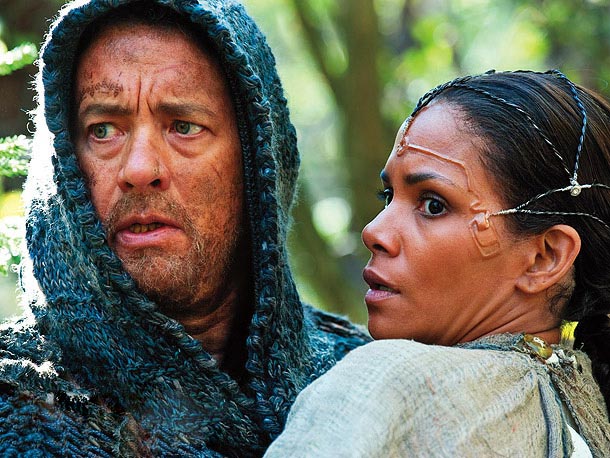
Of course, there's also the make-up. Many an actor has transformed him/herself with make-up and prosthetics, but never like Cloud Atlas. Every major player in the ensemble undergoes radical transformations across segments that include changes in race and gender. Part of the fun of the experience is figuring out who's who. Whether or not Cloud Atlas succeeds in being mindblowing as a whole is debatable  but I'd be hard-pressed to find someone not won over by the extraordinary efforts of the hair and make-up teams.

Before I forget, however, there are actually people doing interesting things infront of the camera as well. Though some members of the ensemble are more prominent than others (Susan Sarandon feels largely underused), the cast is generally a marvel. No individual flies far ahead, but the performances all register nicely. Near the top of the crowd are Doona Bae, most prominently featured as a clone named Sonmi-451, and Ben Whishaw, best utilized as a struggling gay composer. Tom Hanks also surprises, in roles that range from cartoonishly evil  to tenderly sincere. With so much ground to cover, the performers have few notes to play, though they hit them more often than they miss.

But looming larger than any character (or prosthetic nose) are Cloud Atlas's ideas. The idea that "everything is connected" has certainly be done before on film, but perhaps never on such a ludicrously large scale. To meld time periods and genres in pursuit of grandiose New Age wonderings is the sort of philosophical undertaking that could easily sink a film. How well it succeeds is somewhat difficult to describe. The connections between and among segments are often beautifully handled, never spelling things out so much as finding elegant and entertaining links to and from the various stories. Though separated by decades and centuries, part of what works in the film is that the connections evolve and deepen as time progresses. If Mitchell's novel was set up as a Russian nesting doll, then this adaptation is more akin to a very large jigsaw puzzle.

The inevitable drawback, however, is that with so much work put into simply telling the stories, there isn't quite enough room for the film to come together at the end. Each story has its own progression and arc. Each story has heroes and villains. But even as the pacing escalates up and down throughout the final hour, Cloud Atlas ends more with a whimper than with a bang. Moments that could elicit either immense awe or deeply felt sadness instead connect on a much more shallow level. Plot and construction are a critical part of the story's overarching themes, but in the transference to the big screen, the human element hasn't translated as fully.

The most immediate comparison I can make is Darren Aronofsky's The Fountain (2006). Despite being half the length (and also containing only three story strands), it's an equally ambitious film. And despite the differences in length and number of characters, both films work on certain levels, but are held back by certain deficiencies. For Aronofsky's film, it was the narrative and thematic elements that felt incomlpete, whereas in Cloud Atlas, it's the characters. Both weaknesses prevent the films, despite their strengths, from reaching their (insanely high) potential.

 I have no doubt that many will disagree. Like The Fountain, Cloud Atlas is likely to be the love it/hate it film of its year. Yet once again I find myself in the curiously small middle ground. I merely liked and admired what the Wachowski's and Tykwer created. At the very least they succeeding in telling six  engrossing stories - non-sequentially, mind you - over the course of three hours. In an age where big studio projects are built increasingly to move fast, be simple, and make money, Cloud Atlas is something of a relief. As A.O. Scott of The New York Times put it in his review, this is "the most movie" you can get for your eight (ten? twenty?) bucks. Yet considering how much "movie" I got from Cloud Atlas, it's hard not to be left a little wanting. That this film exists is something of a miracle in this day and age. A shame that it exists and only partially succeeds in reaching its lofty goals, which are left floating somewhere up in the stratosphere.

Grade: B

Sunday, January 15, 2012

[Short] Review: "The Iron Lady" (2011)


When tackling a figure as divisive as Margaret Thatcher in film, one is bound to run into more than a little bit of controversy. So it's surprising that Phyllida Lloyd's The Iron Lady, though certainly a flawed film, does a halfway decent job of neither lionizing nor demonizing Britain's first (and thus far, only) female Prime Minister. Though the film is generally supportive of Thatcher's goal to rise in the ranks of politics to "do something, not be something," it does at least show the opposition. And in one of the film's best scenes, Thatcher doesn't come off as a tough leader, but rather an icy bully who has become that which she once feared: an out-of-touch politician. At its core, this is Meryl Streep's film, through and through, and even though the material may not be as deep and rich as it could be, Streep is compelling (and that's putting it mildly).

Unfortunately, when Streep isn't playing Thatcher, the film's weaknesses become more apparent. As incarnated by Alexandra Roach, Thatcher (maiden name: Roberts) comes across as grating, despite making some solid points as she takes her first steps into politics. The film also wastes an unfortunate amount of time on Thatcher in the present, portraying her as a hunched-over old woman on the border of senility. Sections like these hold the film back, and a more linear approach would have been welcome. Still, as much of Thatcher's life as The Iron Lady covers, Lloyd and crew can at least feel proud that they've made a better life-and-times portrait than Clint Eastwood did with J. Edgar (there's something I never thought I'd ever write). Yet even in its best moments, The Iron Lady can't resist the temptation to get a bit montage-y with Thatcher's political career, which should have been the bulk of the film's 105 minute run time. Instead, what we're left with is an engaging, albeit patchwork-y and uneven, portrait that features a compelling central piece of acting, even if the film as a whole isn't as important as its subject would suggest.

Grade: B-/C+

Monday, January 24, 2011

"Another Year" - REVIEW


The title and premise of Mike Leigh's latest film, Another Year, suggests the potential for a lagging, meandering, and weightless slice of life. It's the sort of film that could have easily sunk into tedium, especially considering its two hour run time and very limited plot/story. And yet through a key stylistic difference (I'll explain in a minute) and a strong group of performances, Another Year turns out to be one of the director's finest, and this is coming from someone who isn't exactly a fan of his.

Tom and Gerri (Jim Broadbent and Ruth Sheen) are a happily married couple living in the London area, and over the course of the film (broken up into four segments; one for each season), we see them interact with various friends and relatives, usually at a meal or outing. Yet the film doesn't begin with Tom or Gerri. An entire first scene goes by without either of the two appearing, and the focus of the scene is on a woman who only appears once more (in the very next scene) in the entire film (Imelda Staunton). On the other end of things, the film concludes with a lingering shot on someone other than Tom or Gerri as well. I bring this up because it plays into the strange discussion that has dominated talk of the film's awards season prospects: is actress Lesley Manville - as Tom and Gerri's friend Mary - in a leading or supporting role. Judging the film based on how it begins and ends, I got the sense that while Tom and Gerri ground the film, they aren't exactly the leads (at least not the primary leads). We may not see Mary at home or by herself, but she's the character we get to know best over the course of the film.

Either way, it's a shame that Manville has been largely overlooked over the course of awards season, because her work here stands among the best of the year, lead or supporting. Mary may not exactly have her life together (as evidenced by the jumpy manner in which she moves and talks), but Manville is careful not to take the performance to the point where she becomes annoying or exhausting. And part of this is, perhaps, due to one of the key changes that Leigh seems to have made in this film: he's either cut down on improvisation, or his direction and his actors have made their improvisation less obvious. So even though the film may still feel a little long in some parts (the final section, Winter, goes on just a little too long), the film has the overall feeling of being better constructed and less open than much of Leigh's previous work.

This is also, in large part, due to the strength of the performances. Manville may be the MVP here, but she's beautifully backed up by Broadbent and Sheen, along with smaller turns from David Bradley (AKA Mr. Filch from Harry Potter) and a stunning cameo performance from Imelda Staunton. Staunton in particular nails her two scenes at the film's beginning as a woman whose situation, though never specified, is in shambles. Despite the bleak nature of her scenes, she's one of the supporting characters you wish that Leigh would bring back in. Alas, that might have proven to be too much, and would have weighed down the film's happier segments (Spring and Summer).

But this is where we come to one of the problems with the film. Despite the general quiet warmth of the film, at times it does seem a little condescending. Everyone around Tom and Gerri is usually a mess of some sort, and they're all single, whether through divorce (Mary) or death (Tom's brother). The film seems to treat Tom and Gerri as slightly superior to everyone else simply because they're a happy couple, as though the only way to achieve happiness and stability in life is to be with someone. It's not a glaring issue, but it rears its head enough times to make it somewhat noticeable. The last shot also seems to reinforce this (while simultaneously evoking Mary as actually being the film's lead). For Tom and Gerri, the course of the film really does depict just another year, but for people like Mary, it depicts another year of loneliness and dissatisfaction.

Thankfully this is an issue that never becomes so prominent as to drag down the entire film. Leigh's writing, while a times a little drawn out, is effective at showing the connections among his characters, and his actors do a strong job of projecting a sense of camaraderie. And while it may not be as heartwarming as it's been advertised, it rings true enough in the right places to remain effective without becoming hopeless or bleak. And despite its title, it certainly deserves to be given a chance, because this is more than just Another Mike Leigh Film; it's one of his best.

Grade: B/B+