Showing posts with label Reviews. Show all posts

Saturday, March 11, 2017

Review: "Frantz"


Director: Francois Ozon
Runtime: 113 minutes
At around the 50 minute mark, Francois Ozon pulls back the curtain on the big question lingering over his latest movie. It’s skillfully handled and beautifully acted, but then you realize that there’s still an hour left. What on earth can fill up that much time? Based on Ozon’s track record, anything is on the table. The remainder of Frantz, his latest endeavor, could meander and overstay its welcome. Or, just maybe, it has something else up its sleeve to justify laying its cards on the table so early. For those who have followed the director through his ups and downs, you can breathe easy. This time he’s not only sustained his narrative momentum, but actually built one of the most carefully layered stories of his career.
Ozon’s gift and curse has always been his efficiency. Like Woody Allen, he shoots quickly and hops from one project to the next. And, like Allen, this is not always a good thing. Ozon’s prolific nature means there are plenty of entries in his filmography that, while not bad, nevertheless feel half-baked. His previous effort, 2015’s The New Girlfriend, certainly suffered from his own speediness. As did 2014’s Young & Beautiful, which had its strengths (most notably its conclusion), but still felt a bit like a sketch, rather than a fully-realized idea.
But when Ozon really puts his mind to it, his efficiency can yield powerful dividends, as is the case with Frantz. In the tradition of Swimming PoolUnder the Sand, and 2013’s In the House (his most recent full-blown triumph), Frantz showcases the writer/director’s gifts working at full power. Ozon’s own restlessness, after a few cycles of disappointments, has once again manifested in the form of crisp, surprising storytelling anchored by intelligently chosen backdrops designed to enhance and inform the spare drama on screen.
Set in the the almost immediate aftermath of World War I, Frantz opens not in France, but in a rural village in Germany. There we meet Anna (luminous newcomer Paula Beer), a young woman mourning the death of her fiance (the titular Frantz), while doing her best to maintain a normal life among her would-be in-laws. Then one day she finds flowers on Frantz’s grave from an unknown mourner. Mere hours later, she meets the man responsible: a young Frenchman named Adrien (Pierre Niney, adorned with a toned-down Dali moustache). Anna’s father-in-law to be (Ernst Stotzner) is initially abhorred by the Frenchman’s presence (in his mind, any and all French men are guilty of his son’s death), but Anna and her mother in law (Marie Gruber) are more receptive.

Ozon introduces Adrien so quickly that it’s almost a shock he waits until 50 minutes or so before the big revelation. Yet all throughout there are both clues and red herrings, rendered with great subtlety through both the dextrous script and intuitive performances. Even before we grasp the extent of what’s going on, the nimble movements on the actors’ faces speak volumes. Said volumes only increase in meaning in retrospect, when the full weight of the story reveals itself.
One can easily make the argument that Ozon is France’s answer to Pedro Almodovar, and it shows here, albeit with less florid execution. Shot mostly in crisp black and white (calling to mind The White Ribbon), there are times when the secrets and half-truths of Frantz seems like they might collapse in a heap of melodrama. But, delicate as the set up may be, Ozon uncharacteristically maintains his balance the whole way through. There are no odd diversions or subplots. The more traditional mystery gives way to a deeper, richer examination of grief and perception, all plotted with an efficiency that miraculously never undercuts the emotional depth of the story.
With its big twist planted squarely in the middle, Frantz risks coming off as two separate stories vying for attention. But Ozon’s playfulness with structure continuously reveals itself to be a tremendous boon. The two halves of Frantz clever play off of each other, with the latter functioning as an inversion of the former. And in the second half, Ozon avoids mere repetition, and instead deepens both his characters and their existential quandaries. Ozon refrains from directorial theatrics, focusing instead on simply telling a story full of movement with exceptional control.
Aside from one character’s change of heart in the first 20 minutes, everything in Frantz flows together authentically. These are ordinary scenes in the hands of a gifted storyteller with the skills to bring out the extraordinariness lying just under the surface. So often with Ozon’s work, the lack of immediate passion in one’s response signals that a viewer is shrugging off a well-crafted yet hollow provocation. Here, however, the delayed response is only a tease, with the real treat lying in revisiting and replaying the conversations that oh-so-delicately prop up this sumptuous exercise in melodramatic classicism.
Grade: A-
Frantz opens in NY and LA on March 15, 2017.

Review: "Logan"


Director: James Mangold
Runtime: 135 minutes
In Hugh Jackman’s 17-year tenure as Wolverine we have had two Batmans, two Supermans, two Hulks, two James Bonds (the most recent of whom is soon to be done), and now three Spider-Mans. Even Jackman’s co-leads in the X-Men films like Patrick Stewart and Halle Berry have seen other actors play their younger selves. In that span, superhero movies dug themselves out of their graves and burst forth as key priority for the major studios. Before X-Men‘s release in 2000, a sequel (let alone a franchise) was anything but assured. Now, we have interlocking stories being planned and scheduled through the start of the next decade. With all of those seismic shifts, the end of Jackman’s time in his star-making role is momentous in its own way. The character will always outlive the actor, even if that actor is how most envision said character.
The very good news, however, is that this swan song for the Australian actor corrects the mistakes of past X-Men films, while also building on the promise of a previous installment. After the enjoyable but run-of-the-mill X-Men: The Last Stand (2006), the next film in the franchise was a prequel centered on Wolverine’s origins. It came out in 2009, and it was a bit of a mess. Redemption followed with 2013, when James Mangold (Walk the Line, the 2007 3:10 to Yuma remake) helmed The Wolverine, chronicling the clawed mutants exploits in Japan. But The Wolverine‘s success came with an asterisk: it was a big step in the right direction in many way….until the third act, which went heavy on cartoony effects at odds with what came before.
Yet ultimately The Wolverine did enough to pave the way for Logan, so we owe it that much. With Mangold back in the director’s chair, and the freedom of an R-rating, the third time really is the charm for the cigar-chomping anti-hero. It is a Wolverine story that has its own look, its own feel, and despite references to events in other movies, enough narrative confidence to stand on its own.
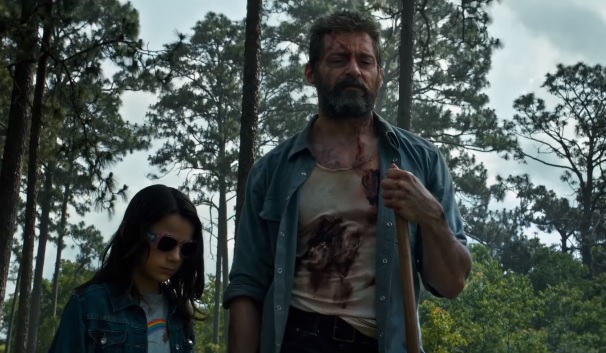
Opening in 2029, we first meet Logan sleeping in his car, drunk out of his mind. His hair is greying, and his body, though still imposing, looks worn. The character used to be able to heal from nearly all injuries, and now he looks like a man on his last legs. In a world where most mutants have been eradicated (and no new ones have been born), the likes of Logan and Prof. X (Patrick Stewart, also bowing out of the franchise) are relics. They live modest lives, hidden away from general society. No coordinated costumes, no fancy lairs, no custom jets.


logan2
Dafne Keen and Hugh Jackman

And then along comes a One Last Job opportunity, which our hero reluctantly takes just for the money. At first. The task is to escort a young, “gifted” girl named Laura (Dafne Keen) from the Texas/Mexico up to North Dakota. Naturally, there are obstacles, including a scheming scientist (Richard E. Grant) and a mercenary with a robotic arm (Gone Girl‘s Boyd Holbrook). At its heart, Logan is a Western-tinged road movie, albeit one with a stray few sci-fi elements.
But its also a movie that generally takes as much care with its interpersonal scenes as it does with its carnage. The characters are often on the move, but it’s rare that Mangold’s storytelling feel rushed. This is heightened by the surprising plot structure, which builds to a major moment that could serve as an ending, only to launch immediately into that story’s sequel. But it doesn’t feel jumbled or inelegant. Mangold is in his element here, crafting a story that has its share of action (a vehicular chase is the standout of the first half), but isn’t afraid to throw in the occasional long stretch of quietude.
It’s easy to sneer at idea of a script being a valuable component of a superhero blockbuster, but a good deal of credit belongs to the foundation Mangold and his two co-writers set. Logan takes into account the past stories of the X-Men, while also demythologizing them. In the film’s world, a comic series about the mutants exists, and one key scene involves Logan telling Laura that most of what’s on those brightly-colored panels is bullshit.
But even if the mutant exploits have been exaggerated, they stem from a shred of truth, even if it’s a truth that Logan would rather avoid: he has gifts that he (and others) can use to help the defenseless. That rediscovery is crucial to the character’s development. It’s certainly been done before (perhaps one too many times), but in Logan the arc comes across as a genuine priority, rather than an obligation.
This is never more clear than when looking at the work from the cast. No one’s here to just fool around, pose, and collect a paycheck. The central trio of performances (Jackman, Stewart, Keen) are excellent and unexpectedly moving. For the two gentlemen who have been with these characters from the outset, it’s a chance to bid farewell to a role (and the audience that came with it) with conviction. Wolverine/Logan in his normal state can be one-note. But this figure, who shows actual signs of wear and tear, allows Jackman the chance to put some emotional weight behind the gruff exterior. That the villains are a bit pedestrian ends up not mattering much. The more frightening enemy is the ravages of time, making themselves felt on a character who spent over a century never fearing them. Who knows, maybe Cormac McCarthy ghost wrote a draft of the script.
Logan is undoubtedly striving to be something “adult” and “grounded,” and it succeeds because when it has a chance to go big, it subverts expectations and goes small. Even when Logan goes into full, R-rated berserker mode, it doesn’t last forever or totally save the day. This is a superhero movie with limitations and consequences (many of them involving dismemberment).
The violence and the special effects are there, but they are always in service of a story where violence continuously bequeaths violence, and takes no prisoners (including children) along the way. It is solemn, but with a few flickers of levity to prevent portentousness. There are references to cinematic influences both subtle and overt (at one point several characters watch Shane on TV), but the tributes have been assembled to tell a story that uses familiar settings and tropes to create a tale with its own identity.
Will Logan/Wolverine rise to fight another day, with another face? Almost certainly. With iconic characters like Superman or James Bond, certain faces stick with roles more than others. But new casting does allow for variations on how a noteworthy role is portrayed (contrast Connery’s suaveness with Daniel Craig’s Bourne-like grit) can reflect changes. Few, however, have played a character through so many stylistic evolutions and remained a constant. So, to the person tasked with filling the shoes with nearly 2 decades of work from Jackman, I can only say: good luck; you’ll need it.

Grade: B+/A-

Saturday, February 25, 2017

Review: "Get Out"


Director: Jordan Peele
Runtime: 103 minutes

Ambiguity is the name of the game for so many horror classics, especially those involving a domestic setting (Rosemary's Baby). Is the central character really dealing with evil and/or the supernatural, or is it - to some degree - all in their head? That first act ambiguity is a powerful part of what helps so many movies land their big twists. And yet, it's not the only way. In the new film Get Out, we know something is "off" with the environment the protagonist wanders into. The question, then, revolves around the degree of maliciousness lurking beneath the placid surface. The answer, courtesy of Key & Peele's Jordan Peele, could not be more satisfying. 

Peele's background (he started on MadTV before creating the aforementioned sketch show with Keegan Michael-Key) would suggest that his point of view is best limited to the short bursts provided by the late night format. Yet with Get Out, Mr. Peele has proven himself more than capable of taking a timely premise and stretching it to its appropriately absurd endpoint without losing steam. 

So what, pray tell, is this thing about? Well, it all starts when Chris (Daniel Kaluuya, of Sicario and the "Five Million Merits" episode of Black Mirror) goes with his girlfriend Rose (Girls' Allison Williams) to meet her upscale parents (Catherine Keener and Bradley Whitford). Some would suggest going in as cold as possible. I, through luck, read a draft of the script last summer. Yet even knowing where every twist and jump scare was located, I nonetheless found myself white-knuckling my way through....even as I was cringing or laughing hysterically. As others have pointed out, the story is essentially Look Who's Coming To Dinner crossbred with The Stepford Wives. But even with those obvious influences, it's hard to deny that Get Out is its own thrillingly unique piece of work.

In the past few years, the issue of race relations has been thrust into the American consciousness in uncomfortable ways. As marginalized voices utilize modern tools, our (by "our" I mostly mean white people) understanding of the degrees of systemic and cultural racism have been burst wide open. It's not just a matter of MLK vs. the KKK. It's all everything from flat-out declarations of racism to the understated, yet equally insidious, actions often referred to as micro-aggressions. You think the KKK is bad? Congratulations, but that doesn't mean you've never engaged in or benefited from other mutations of racism.

If all of this makes Get Out sound like a harsh lecture, fear not. It's entirely possible to enjoy Peele's story-telling based on thrills and scares alone. But I'd also argue that one's enjoyment would only increase by directly engaging with the assertions (both serious and tongue-in-cheek) of Peele's film. The subtext is not tacked on as a cheap play for socio-political relevance. It's a necessary part of telling this story, as outlandish as it becomes, well. 

And what a story it turns out to be. After two acts of planting hints and making sinister suggestions, the homestretch arrives, and it's nothing short of a masterstroke of racially-charged satire. To call the film's finale "bonkers" would do it a disservice. It's certainly insane, but built so organically off of everything that came before that it all feels wholly earned. Peele's direction is nimble, even when dealing with exposition. His actors, meanwhile, are uniformly excellent. Mr. Kaluuya is effortlessly compelling as the story's anchor (one hopes this is the film that will catapult him onto the A-list), never more so than when undergoes a session of hypnotherapy with Ms. Keener. A marvel of directing, staging, and acting, the sequence hinges on Kaluuya's emotional nakedness in the moment, and he nails it, without ever straining for a false sense of dramatic importance.

But, at least for white audiences, the real shock here is Williams. Rose is much more than the cheerful girlfriend, and Williams handles the character's shifting allegiances without ever falling out of step with the carefully-balanced tone. Imagine Williams as her character from Girls, and the whole thing somehow becomes even funnier and dead-on. Marnie can be astounding in her lack of self-awareness. By contrast, Rose enables Williams to play a multifaceted character with an outside acknowledgement of her biases and prejudices. Rose may not always "get it," but Williams clearly does, and the results are riotously good. The old adage goes "art should comfort the disturbed and disturb the comfortable." From a white viewer's perspective, it's through Williams that this notion hits home. I was tense, I laughed out loud, and yet somewhere deep down, I was left vaguely nauseous. We're meant to identify with the millennial, "woke" girl who has no issues whatsoever dating a black guy, and is embarrassed by her parents' forced hipness with black culture. By the end, those implications are deeply funny. They're also scary as hell.

Grade: B+/A-


Monday, January 2, 2017

Review: "Silence"


Director: Martin Scorsese
Runtime: 161 minutes

Martin Scorsese has been grappling with his Catholic faith for his entire career, even when it seemed the least obvious. The intensity of his religious convictions, as well as the intensity of his questions and severe doubts, have manifested in ways both literal (The Last Temptation of the Christ) and abstract (Taxi Driver). Catholicism (or, in a sense, any faith) is the third pillar at the foundation of his filmmaking, seated right alongside masculinity and violence (and all of the intersections among the lot). 

Though Scorsese remains an impeccable craftsman, often invigorating his material with dynamism of someone decades younger, he has recently started to run on fumes when dealing with story's beyond their basic text. The Wolf of Wall Street tackles excess, but to the point of becoming excessive itself. Even Best Picture winner The Departed, though powerfully acted and edited, comes up short when one looks for something to chew on beyond the bloody bodycount. 

The apparent exhaustion of two of Scorsese's thematic pillars (well, for now) has left a clearing for capital F Faith to grab the spotlight all for itself. After an on-and-off journey of roughly 30 years, Scorsese has taken Shusaku Endo's novel "Silence" and brought it to life on the big screen. Here, the man who almost became a priest turns his camera to meet not just his maker, but the ideals and practices of those serving in his name. And, while not without its faults (largely at the outset), Silence ultimately proves itself to be a worthy landmark moment of the latter stages of Scorsese's career. Regardless of your religious persuasion (or lack thereof), there is a tremendous amount of value in the issues raised in this exhaustive and exhausting work of Catholic cinema. Though not the director's most polished or lush work, it more than compensates with its staggering devotion to crafting a drama filled with ideas about the earthly and the transcendent. 

Yet much like the film's journey to the big screen, Silence is not without its hiccups. The earliest passages, concerning Jesuit priests Rodrigues (Andrew Garfield) and Garrpe (Adam Driver) seeking out a former mentor in 17th century Japan, come off as stilted. Despite some striking, simple visuals, Silence begins by playing things in a strangely safe manner. At times, it even seems shockingly amateurish. Even longtime Scorsese editor (and basically co-director) Thelma Schoonmaker isn't immune, and turns in some of her weakest work to date. Simple conversations change angles with a frequency at odds with such contemplative subject matter. And Mr. Driver, though an intriguing casting choice, can't quite master what is supposed to be a Portuguese accent (the Portuguese characters speak in English). Early on, a few lines escape his throat like a squawk from a goose raised in the Bronx. Garfield generally fares better, though even he is not without his stilted moments. It's not an auspicious beginning, especially for a film that is so clearly a labor of passion. 

But the further the two Jesuits step into the so-called "swamp of Japan," the more Silence finds its footing. The beauty of Endo's novel, which Scorsese has wisely left intact, is its refusal to sugarcoat or simplify the conflicts at hand. And what conflicts they are. On the surface, Silence's tale involves priests administering aid to Japanese Christians living under persecution. In less enlightened times, such a socio-political conflict would have likely been sanded down to lift the Jesuits up as Christ-like figures. Scorsese includes such a moment, though it's hardly presented as sincere. Alone and starving, Fr. Rodrigues finds himself confronted with his reflection. After a moment, the face transforms into a familiar sight: a Goya painting of Christ's face which we've been shown as how Rodrigues imagines the Lamb of God in his prayers and meditations. Garfield, with his thin features and his hair grown out into a magnificent mane, makes a fitting vessel for this sort of transfiguration. 

The moment, alas, does not come greeted with a moment of intervention or inspiration. Rodrigues bursts into unsettling, hollow laughter. In his manic, dehydrated state, he seems ecstatic with such a vision, but the tone and timing suggests the sort of madness one would find in a 70s-era Herzog drama. Yet Scorsese curtails the sequence before such madness turns hallucinatory. Rodrigo Prieto's images, even at their most painterly, have an air of reality to them. The staging thrives on ordinariness, rather than elaborately constructed tableaus.

All the better, then, to enable the film to cut to the heart of its conflicts. Somewhere towards the middle (I think) of the film, Silence shifts from acting as a drama about the faithful, and morphs into a searing interrogation of men of the cloth and their motivations. Rodrigues meets a number of foils among the Japanese, chief among them a translator (Tadanobu Asano) and the inquisitor Inoue (Issei Ogata). Though radically different in their approaches, the two men proceed to challenge not just Rodrigues' convictions and his mission, but the core of Catholicism itself, as well as its place in a country like Japan. 

And it's here, when it's most bound to simple scenes of people talking, that Silence finally grasps the intangible profundity it's been reaching for the whole time. Asano and Ogata make excellent philosophical adversaries for Garfield's Rodrigues, with Ogata in particular relishing every word (among his most notable jabs: "the price for your glory is their suffering.") So many faith-based films use Christian conviction as a crutch, including this year's Hacksaw Ridge, which also planted Mr. Garfield at the center. With that baseline established, a film like Silence becomes all the more remarkable. Here is a drama with source material from a Catholic writer (albeit a Japanese convert, and not a European), directed by a passionately Catholic director, that avoids turning its protagonists into the one-note martyrs they secretly wish to be. 

The most magnificent wrench of all, however, comes in the form of Fr. Ferreira (Liam Neeson, thankfully not even attempting the accent). In addition to administering to the persecuted faithful, Rodrigues and Garrpe have snuck into Japan to seek out their former mentor, who has been rumored to have renounced the faith and taken up life as an ordinary member of Japanese society. Ferreira's eventual return to the narrative (best left unsaid) gives Silence a final headbutt of ambiguity, heightening the specificity of the film's conflicts, while simultaneously making them all the more universal. Neeson, in his all-too-brief screen time, is nothing short of mesmerizing. In such quick moments, he conveys Ferreira's decades of work in Japan, and the toll it took on him. Ferreira's exploits could have easily been their own film, and the way Neeson takes the bones of Scorsese and Jay Cocks' script and turns it into its own meal is nothing short of astonishing. It's a masterful moment of teaching both for Rodrigues and the viewer, the complexity of which has stayed with me long after the lights went up in the theater.

In my four years at a Jesuit-led high school, one of the theological ideas that I remember most is that faith without room for doubt is not really faith, but merely blind obedience. That remarkably nuanced notion, standing in such stark contrast to the right wing extremists now posturing as 21st century moralists, has stayed with me even as whatever religion I had slipped away. And, whatever my personal beliefs now, that Catholic and Jesuit identity (hello, Catholic guilt, you old bastard) is still etched, however faintly, in my being. To see that same sort of depth is a monumental intellectual achievement, one that overrides the vagueries that somewhat plague the central role of Rodrigues (he is both an individual and a representative of the faith as a whole, though not quite to the degree where it feels possible to empathize with him enough). With such a long wait, it would be tempting to hold Silence to the standard that anything less than a masterpiece would be a letdown. To do so, I think, would be to dismiss the tremendous accomplishments on display. Rodrigues and Garrpe may find themselves starving, but their story is veritable feast of ideas, the strengths of which are made all the more powerful by their existence alongside the flaws. 


Grade: B+

Saturday, December 3, 2016

Review: "Jackie"


Director: Pablo Larrain
Runtime: 99 minutes

Though it features only the briefest moments of blood and gore, there is something so deeply immersive and unsettling about Jackie that made me queasy. The lives, legacies, and tragedies of the Kennedy clan have been in the public consciousness for decades. Movies, miniseries, plays, novels, and conspiracy theories about the Kennedys have congealed into their own industry, and that industry has taken hold as its own sub-genre of American culture (Kennedy Kitsch? Kennedy Camp?). Yet none have pierced through shield of the Kennedy mythos quite like director Pablo Larrain. A native of Chile, Mr. Larrain's English language debut, despite centering on American royalty, feels as fresh and urgent as his film's directly tied to his homeland's socio-political conscious.

Even though Jackie opens with a familiar framing device (the subject is being interviewed, with length flashbacks filling in the gaps), Larrain is quick to distance himself from decades' worth of mythologizing and hagiography. Before Jackie O (Natalie Portman, astounding) even appears on screen, the viewer is jolted by the otherworldly strains of the score. There are no patriotic tunes of either the upbeat or mournful variety. Instead, avant garde composer Mica Levi (who also wrote the haunting music for Under the Skin) floods the soundscape with a swirl of alien notes and tones. The score, which seeps out like a frozen, enveloping embrace, is disorienting to brilliant effect. 

The Kennedy brothers (Jack is Caspar Phillipson, Bobby is Peter Sarsgaard) make their appearances throughout Jackie, but Larrain and screenwriter Noah Oppenheim keep the focus on the titular First Lady of Camelot. With whole life thrown into chaos, Jackie finds herself being unravelled at all angles, and Levi's music does an overwhelmingly powerful job of communicating her emotional discord. There are no elaborate swooping camera moves in Jackie, but Levi's music and Stephane Fontaine's images mix like vodka and Xanax. It's off-putting, then hypnotic, and climaxes with a sense of dissociation that leaves your nerves exhausted, your mind numb, and your innards hollow and tumultuous.

Jackie sustains its limited premise through its craftsmanship, but it's thanks to Portman that it transcends. It's a brilliant example that proves finding the right actor to play a historical figure goes beyond (and can even exclude) exact likeness. Portman's features have some glaring differences, and there appears to have been no use of padding or prosthetics to bridge the gap between artist and subject. Yet the instant those rounded words glide out of Portman's mouth, all doubt vanishes: it's her. 

Of course, vocal inflections and the right hair do not a rounded performance make, and Portman and Larrain are well aware of this. Oppenheim's screenplay, aided by Sebastian Sepulveda's editing, positions the various flashbacks like an orchestra of mirrors. They reflect and refract, with Portman functioning as the story's anchor more so than the scenes involving the journalist (Billy Crudup). Even if everything had been handled with an emphasis on linearity, it would do nothing to diminish Portman's work, which takes Jackie O through so much complex emotional territory and distills it into a character both deeply empathetic and not quite of this world (often at the same time). In short, it makes Portman's Oscar-winning performance in Black Swan look like amateur hour. 

The driving thesis of Jackie, which is pointed out early on, concerns reality's relationship with historical narratives and fairy tales. Portman, Larrain, and Oppenheim repeat the idea a few times (perhaps one too-many), but consistently find new ways to play it out in scenarios that feel possible and plausible, even if some liberties are taken in the name of drama. Did Jackie O ever try on a bunch of her clothes, sashay through the White House in a drug-and-booze addled stupor with the soundtrack to Camelot blasting out of the record player? I'm perfectly content never knowing the answer. Reality and history make strange bedfellows, and that discomfort lies at the heart of what makes Jackie sing so beautifully as a film. Larrain, whose dramas sometimes squander great set-ups on drawn-out, overwrought execution, could not have been a more inspired choice. 

Larrain's perspective is a thrilling compliment to the American iconography on display, and he guides Jackie's journey with masterful control of timing and tone (Oppenheim's script includes some welcome moments of mordant and mournful wit). Few scenes this year will merge great writing, acting, and directing the way Jackie does when the First Lady appears to break the news of JFK's death to her children. It is mesmerizing, stomach-churning, white-knuckle intense, and ultimately shattering. Larrain's guiding hand, Portman's face, and Oppenheim's words (and silences) take two horrendous moments (one personal, one political) and blow them up to operatic proportions: The President is dead...My husband is dead...My husband the President is dead. Those unspoken statements hang there through all of Jackie, and their weight only increases with time. When Crudup's journalist asks Jackie if she has any advice, she replies, "Don't marry the President." After spending just over 90 minutes in Jackie's head, you'll understand why.

Grade: A


Saturday, November 26, 2016

Review: "Allied"


Director: Robert Zemeckis
Runtime: 124 minutes

All's murky in love and war, especially when you and your spouse have both spent time working the international espionage racket. So goes the world of Robert Zemeckis' Allied, which oscillates between Casablanca homage and grim antidote to Mr. and Mrs. Smith. Despite a twisty set up, generally strong production values, and solid performances, Allied comes up short when it's time to wrap up its mission.

While much of what we see on screen has a welcome Old Hollywood gloss, Zemeckis' recent love of visual effects starts Allied off on a distractingly modern note. A rather embarrassing opening shot follows a hilariously fake parachute landing into a desert landscape that's only marginally more convincing. Emerging from the fakery is Max Vattan (Brad Pitt), who has arrived in French Morocco to meet up with a French resistance operative to take out a Nazi ambassador in Casablanca. The operative turns out to be Marianne Beausejour (Marion Cotillard, in full Golden Age glamor mode), who helps Max pose as her (fake) husband prior to the assassination. For Marianne, the trick lies in keeping the fakery of their work grounded in some kernel of authenticity.

It's notion that Cotillard pulls off beautifully, making it all the more frustrating that the film around her often fails do follow suit. Allied's sets and costumes are richly designed, but there is often a certain sheen to the imagery which goes beyond romanticism and into fakery. An early scene set in a Casablanca plaza looks the part at first glance, but the longer you soak it in, the more it appears to take place in a vacuum. Tilt the camera the wrong direction by just an inch or two, and the framework of the soundstage would make an unwelcome appearance.

Thankfully, things improve once the action moves back to England. Max and Marianne's fake relationship blossoms into a genuine one, and they settle down and have a baby. Then, right on schedule, the other shoe drops: British intelligence informs Max that Marianne may be a deep cover Nazi spy, and that he'll need to set up a trap to prove her innocence or guilt. 

The answers that eventually come our way, courtesy of screenwriter Steven Knight, largely prove satisfying. Whatever quibbles one might have with the plot's internal logic, Allied boasts enough first rate design and star power to allow for comfortable suspension of disbelief in the moment. But while Knight's story is a fun guessing game, Zemeckis' direction often gets in the way. Allied's opening passages are punishingly slow, with the build up to the assassination taking up far too much time. The Casablanca scenes lay the necessary groundwork with clues and red herrings, but Zemeckis directs on autopilot through much of it. Spycraft lives or dies by the details, but in Allied, those details exist as exposition that need to be trudged through before getting on to the good stuff.

By the time Allied finally introduces the question of Marianne's innocence, you might be ready for the story to just end already. But wait, there's more! The superior second half, when finally given room to take off, is no faster than the opening, but it moves with more confidence and better sustains the intrigue. Act 1 is an overlong obligation, while Act 2 gets to the heart of the matter. Livening things up are short performances from a strong group of supporting performances filled out by the likes of Jared Harris, Lizzy Caplan (kudos for including an LGBT character), Matthew Goode, and Simon McBurney.

Without enough genuine character development to support the film's star power, however, the bulk of Allied never consistently catches fire. The twists, thankfully, give the story more heft by providing questions worth considering (as opposed to derailing the plot, which they easily could have). Allied's eventual conclusion is convincingly solemn, in large part thanks to Cotillard's multifaceted performance. The story's lack of focus, coupled with Zemeckis' lack of verve, leaves you with the feeling that you've just witnessed a halfhearted take on what could have been a tense mix of romance and thrills. At least Cotillard provides the fizz in an otherwise flat concoction.

Grade: C

Friday, November 25, 2016

Review: "Nocturnal Animals"


Director: Tom Ford
Runtime: 116 minutes

It's perhaps not the greatest sign that the scene that has stuck with me the longest from Nocturnal Animals is the one that absolutely nothing to do with the rest of the plot. A mesmerizing series of grotesques set to Abel Korzeniowski's lush score kicks things off in a way that would make David Lynch proud. What follows, sadly, has the basic blueprints for a mesmerizing Russian Nesting Doll of a story, yet struggles to get beneath the artifice to something worth savoring. Fashion designer Tom Ford, in his second feature, continues to showcase his hidden gifts as a director (following the achingly beautiful A Single Man 7 years ago). And he's assembled a cast of talented actors to make it all sound convincing. But what gets in the way of Ford's Nocturnal Animals is Ford himself...or at least, his screenplay.

Adapted from Austin Wright's novel "Tony and Susan," Nocturnal Animals is either three stories in one or one story fragmented into three volumes. In the first, we meet Susan (Amy Adams), an art gallery owner trapped in an increasingly hollow marriage to a philandering Ken Doll of a husband (Armie Hammer). Susan is jolted from her sterile LA lifestyle when she receives a manuscript for a novel from her ex-husband Tony (Jake Gyllenhaal). As she reads through the draft (also titled "Nocturnal Animals"), she traces the connections between it and her relationship with Tony, which ended under less than pleasant circumstances. 

What transpires is, on paper, a compelling slice of modern noir punctuated with heavy doses of a grimy Texas-set revenge thriller. Working with many of the same technical collaborators from A Single Man, Ford has crafted another luxurious cinematic experience, ranging from the aforementioned music to the chameleonic photography (and of course, the clothes). It looks the part, sounds the part, and even adds a few new tricks to Ford's directorial skill set. The dramatization of Tony's novel (in which Susan imagines Tony in the lead role) kicks off with a terrifically staged car chase on an empty West Texas road, and builds to a chilling climax. 

But what's missing from Nocturnal Animals is the psychological acuity that gave such weight to A Single Man. There's a lot of external activity on screen, but precious little of it gets beyond the surface of the beautiful faces on screen. What transpires often enthralls in the moment, but dissipates soon after. You'll likely find yourself wanting to be investing in these people, but Nocturnal Animals too often refuses to even meet you halfway.

Credit then, belongs to the actors for filling out these roles as best they can. Adams, coming off Arrival, turns in another quiet, introspective performance. But while Arrival allowed the actress room to take her character on a journey, Nocturnal Animals too often relegates her to the same position as the audience: a watcher. She is pushed to the margins, and spends more time staring out of windows and taking off her (admittedly killer) reading glasses than she does contributing to the story. 

Gyllenhaal, though occasionally pushed to go over the top, is also effective in both of his grief stricken forms, while Michael Shannon nearly steals the show as a sickly sheriff in Tony's novel. Taylor-Johnson is suitably menacing, though eventually his backwoods terrorizer schtick becomes repetitive. Actors like Hammer, Andrea Riseborough, and Michael Sheen do what they can with limited time, while Laura Linney makes the most of her 1 scene cameo as Susan's imperious mother.

Just about everything in Nocturnal Animals is at least watchable, and for large stretches it's perfectly engaging. But while the narrative's structural divisions are admirable, their proportions are all off. So much time is spent bringing Tony's novel to life that Susan's current existence and her past life with Tony feel like add-ons struggling to justify themselves. And yet, if you were to cut them out, Tony's novel on its own wouldn't be enough to justify a full film. Ford spends so much time figuring out how to cobble the story together that he seems to have neglected to make even the faintest point out of everything. For all of its beauty, it's the ugly imperfections that linger longest. Nocturnal Animals pretends to get its hands dirty, but upon closer inspection, there's never a speck of dust under its immaculately manicured fingernails. 

Grade: B-


Review: "Things to Come"


Director: Mia Hansen-Love
Runtime: 101 minutes

A deceptive mundanity permeates Things to Come, the latest feature from France's Mia Hansen-Love. The central character, philosophy teacher Nathalie (Isabelle Huppert), undergoes a series of disruptions to her everyday life, yet Hansen-Love refuses to portray any of them as end-of-world scenarios. Though it takes place over considerably less time, Things to Come in some ways recalls Boyhood. It's not entirely a shock; like Richard Linklater, Hansen-Love is fixated on people's various relationships with time, ranging from major life events to the connective tissue that fills up everything else. Yet from the mundanity of Things to Come emerges a whisper of transcendence. The ordinary is not inflated to become something greater than it is. Instead, it's handled with a mix of sensitivity and level-headedness that leads to something warm and wise.

Like Elle, another striking vehicle for Huppert (an actress continually finding new ways to be excellent), Things to Come technically hinges on a life-altering incident. But then it pulls back and forces its protagonist to cope not by putting all of their energy towards it, but by tending to it while still moving along with all else that adult life entails. Elle, with its violent rape and hints of sadomasochism, takes the darker, naughtier route. Things to Come, meanwhile, moves gently, thought not without purpose. Nathalie's life, turned upside down by her husband's affair, proceeds without too many major detours. She still has lunch with her kids, teaches class, counsels former protege Fabien (Roman Kolinka), and deals with her increasingly senile mother (Edith Scob).

Plenty of films have been made involving middle-aged men and women reinventing themselves, but few do so with the wisdom and lack of sentimentality on display here. Following the sprawling dance music saga Eden, Hansen-Love has scaled back her narrative ambitions, and emerged as a more precise storyteller. For a film composed of scene after scene of what amounts to daily life (with a few diversions), it moves with remarkable assurance and focus. It's not exactly hypnotic, but it's gently compelling in its honesty in a way that makes you want to get lost in it all. You may not share Nathalie's age, socio-economic status, or family set up, but her experiences touch on the universal without coming across as a series of bland boxes to be ticked off.

Then again, it's hard to be too bland when you've centered your movie on Isabelle Huppert. The actress is at her softest and gentlest here (compared with her ice-queen work in films like Elle, The Piano Teacher, White Material, La Ceremonie, etc etc), but she remains as galvanizing a screen presence as ever. The ups and downs of Nathalie's life are charted with the precision of an X-Acto knife, yet there's never a moment of the performance that comes off as overly calculated. Huppert has made a career out of playing characters with whom one can empathize, but not always sympathize. In the case of Nathalie, she has both, and the scenes in which her face, a mask of severity and poise, cracks, are breathtakingly moving.

So, as Nathalie moves from one moment to the next, Hansen-Love (who also wrote the beautiful script) follows her with an easy-going refinement that's all too rare in slice-of-life dramas. Even in the film's darkest moments, Hansen-Love keeps it all thrillingly alive. People bicker, people chat, people discuss philosophy, take care of their ailing parents, and sometimes they chase after their obese house cats...such is life (incidentally, between this and Elle, 2016 has been a fantastic year for those who enjoy Isabelle Huppert sharing the screen with felines). Things to Come manages to have it both ways: it celebrates the chance for reinvention, while still placing it in the context of the vast ocean of experiences and routines that define our every day existence. You don't need to be a philosophy expert to find something worth cherishing.

Grade: A-


Review: "Evolution"


Director: Lucile Hadzihalilovic
Runtime: 78 minutes

Brevity is the soul of wit. Turns out that it also lies at the heart of head-spinning psychological thrillers. At just 78 minutes, Evolution, the second film from French director Lucile Hadzihalilovic, accomplishes what similarly themed films struggle to over vastly longer durations. Favoring a steady drip of ambiguous clues over dense plotting and explanation, Hadzihalilovic's first film in over a decade is the cinematic equivalent of a near-perfectly delivered short story that lingers due to the questions left unanswered.

It's not long after we first meet young Nicolas (Max Brebant) that we stumble upon the first of several puzzling, gently unsettling sights. On a morning swim, Nicolas comes across the corpse of a boy his age, with a red starfish fixed around his stomach. Understandably alarmed, he rushes home to his village, a cluster of white buildings isolated along the coastline of black rocks and sand. He informs his mother (Julie-Marie Parmentier), eventually goes under the water to see for herself. When she resurfaces, she comes holding the red starfish, and tells Nicolas and the other boys in town that there never was a dead body. In the meantime, other families, composed of male children and female adults, mill about by the water. 

Hadzihalilovic, from the outset, displays an extraordinary sense of cinematic time, and proportions her film accordingly. Though Evolution would qualify as slow, its pacing is taut, never dawdling for too long before nudging its story into (and then deep down) the rabbit hole. The routines of the village dwellers, which include the adults feeding an inky black mush to the boys as part of a treatment, are shown enough for us to understand their place in the characters' lives, but not so much that the film leaves us thinking "oh come on, not this again." 

Evolution may be light on plot and character development, but it counters beautifully through its stoic performances, beautiful lighting, and masterful command of mood. Much of what takes place defies easy explanation, but the questions that Hadzihalilovic leaves unanswered come from a place of assured filmmaking. The director has the answers and knows all of the rules, and uses ambiguity to push the viewer, rather than as a cop out. And the actors, though often blank in expression, all commit to the material with chilling directness. Though young Nicolas is the film's lead, the most nuanced turn comes from Stella (The White Ribbon's Roxane Duran), a nurse (or someone dressed as a nurse) at the island's medical facility. Initially just another face overseeing the "cure" of the local boys, Stella's facade cracks in an unexpectedly tender way, throwing a wrench into our perception of what the hell is going on.

There's a razor thin line between compelling ambiguity and head-scratching emptiness, and Hadzihalilovic never falters. Her story has literal and symbolic implications, with issues of gender dynamics, societal manipulation, and bodily autonomy all intersecting over the course of Nicolas' journey (not unlike 2014's Under the Skin). It's a muted mix of abstract sci-fi thrills and low-key body horror with a less-is-more approach only amplifies its deeply unnerving psychological impact the longer it swims around in your head.


Grade: A-


Wednesday, November 23, 2016

Review: "Elle"


Director: Paul Verhoeven
Runtime: 131 minutes


It's not every day you see a movie that opens with rape and then, mere minutes later, prods you to laugh uncomfortably. Assault and rape are tricky to tackle in a visual medium, given the thin line that separates honest discomfort and repugnant exploitation (look no further than high end cable dramas like Game of Thrones and Outlander). Leave it to Paul Verhoeven, then, to craft a psychological thriller/black comedy like Elle that occupies the elusive intersection of melodramatic noir thrills and pop-psychology. 

Which is not to say that this is the first time Verhoeven has waded into these waters. This is, after all, the same man who gave us Basic Instinct and Showgirls. It's been a decade since Verhoeven's last film (the Dutch drama Black Book), and above all else, he remains an effective provocateur. Yet in Elle, adapted from French novelist Philippe Djian's "....Oh," Verhoeven reveals that he's moved on from hollow shock value. His new film is a silky smooth, Hitchcockian exercise buoyed by a sharp script and a mesmerizing lead performance.

Verhoeven and screenwriter David Birke provide a sufficiently intricate framework, but the real heavy lifting comes down to the actress who plays Michele, the story's protagonist. In the hands of French actress Isabelle Huppert, it all looks astonishingly effortless. That sort of acting prowess is necessary given the psychological hoops Michele jumps through over the course of the film's two hours. So many (too many) similar female characters have been confined to victimhood in the aftermath of a rape, and Michele is a wonderfully complex corrective. Rather than wilt, Michele does her best to go about her usual routine. So much so, that you'd be forgiven for wondering if the incident had phased her at all.

Verhoeven plays the long game with Elle, and though it can sometimes be a bit bewildering, the approach helps the film standout and surprise. The evolution of Michele's "relationship" with her masked assailant is given as much screen time as her affair with her friend's husband, her garish mother, and the various oddballs and jackasses at her video game company. The revelation of Michele's childhood trauma further throws a wrench into how everything fits together.

Elle has a lot of pieces in its puzzle, but Verhoeven and Birke keep the story flowing along smoothly. At times, certain scenes beg the question "ok, why are we here/where is this going?" Ultimately, the mundanity of some of the narrative works in the film's favor. In giving so much focus to the regular aspects of Michele's life, Elle is able to smoothly compartmentalize its story the way its protagonist does. The story presents dozens of opportunities for Birke's screenplay to take the mawkish, "oh why me?" route with Michele's journey, yet the writer sidesteps them all.

The biting sense of humor is an equally valuable component of Elle's success. Rather than cheapen the gravity of Michele's trauma, the stabs of comedy elevate the film into a richer, more nuanced exploration. The blend of tones reaches its apex in a fantastic dinner party scene, where humor and tragedy collide in subtly breathtaking ways. It's all a high wire act that would fall apart in the hands of a less daring performer. 

Yet even those who know Huppert's work might be taken aback by the way the actress' fearlessness manifests in this performance. In films like Haneke's The Piano Teacher, Huppert demonstrated her prowess through fiercely contained bursts of emotion. Elle, though no less complex, doesn't boast the shame type of obvious expressiveness. But just when it seems like the actress might be coasting, she throws out some little jab of black humor or murky despair that brings the whole balancing act into focus. 

The performance is so strong and so consistently intriguing that it would be easy to dismiss the behind the scenes contributions. First and foremost is Verhoeven's elegant direction, which toes the line between high end psychological drama and paperback thriller. The faded, fall-into-winter color palette works well by casting even the most innocent moments in a murky mood. Anne Dudley's melodramatic score is a standout as well, lending scenes the right touch of menace and mystery without becoming intrusive. Despite the heavy nods to cinematic styles of the past, Verhoeven's stamp on Elle ensures that it all manages to still come across as forward-thinking. Whatever your thoughts on the director's previous work, he at least deserves credit for finding new ways to tease and provoke.

Grade: B+


Sunday, November 13, 2016

Review: "Arrival"


Director: Denis Villeneuve
Runtime: 116 minutes

There is a moment in Arrival in which an observation about language caused me to freeze in my seat. If I was shocked, it was due not to some sensational revelation. For a "big moment," it is played with an almost disorienting amount of elegance and reserve. And yet this delicate, seemingly banal line about the nature of languages (or rather, one language in particular) left me in the same state of awe as the climactic passages of 2001, Solaris, or Stalker. It serves not as a copout, but as a mind-warping enrichment of everything that comes before and after.

Adapted from Ted Chiang's acclaimed short story "The Story of Your Life," Arrival's set up is hardly novel. Aliens land, and it's up to us to figure out what they want (and, in the worst case scenario, to fight back). So it's all the more astonishing that, Arrival has been allowed to exist in its present form. As written by Eric Heisserer and directed by Denis Villeneuve (Prisoners, Sicario), Arrival represents the most extreme opposite of bellicose blockbusters like War of the Worlds or Independence Day. Though the special effects are impressive, they pale in comparison to what is achieved through the enigmatic storytelling, and the haunting lead performance from Amy Adams.

Adams plays Louise Banks, an expert linguist called upon to help the US government following a global incident. 12 UFO's, which look like elongated obsidian eggs, have touched down across the globe, including one in America's backyard, Montana. At the forceful request of Col. Weber (Forest Whitaker), she is rushed out to US-bound spacecraft, and paired with theoretical physicist Ian (Jeremy Renner) to decipher the aliens' intentions. 

Global tensions, understandably, run high, and yet the plot's trajectory never fails to subvert expectations. The linguistics conversations are not an entryway to a standard thriller plot, but rather the launchpad for a richer tale of time, memory, and communication. Deciphering a language, much like editing a book, is not a process that lends itself to screen-drama. And yet, somehow, Heisserer's screenplay often does what so many others struggle to accomplish. The writing is devoted to explaining various connections and theories, but never allows them to grind the narrative to a halt. 

And even when the dialogue becomes purely expository, it is gracefully complimented by Villeneuve's overall grasp on the material. Since making the leap from Quebec, the Canadian helmer has become a first rate director of the sort of mid-budget, adult-targeted dramas that are so hard to come by in Hollywood. With each new project, Villeneuve moves to different genres and settings, yet maintains a devotion to keeping his stories grounded in the authentic. Arrival has far loftier intentions than Villeneuve's previous work, and it works because of, not in spite of, its fantastical elements.

With so much emphasis on ideas and plot trickery, one might understandably fear that the human element of something like Arrival would be an inconvenience. But what ultimately gives Arrival its tremendous impact comes down to its refusal to separate the emotional and cerebral components. The eventual intersection of the large and small scale conflicts, which could have so easily derailed the film, builds to an ingenious series of developments that drastically alter the stakes, but in the most unexpected ways.

Louise is at the center of all of Arrival's plot threads and themes, and Adams is nothing short of stunning in the role. Much like Emily Blunt's protagonist in Sicario, Louise is often quite withdrawn. She is a reactor, not an actor, but that doesn't make her a blank slate. For all of her guardedness, Adams is still tremendously expressive throughout. The movements of her face and eyes appear to hold several lifetimes worth of emotion. Louise is out of her depth, yet somehow has all of the answers. She has moments of understanding, yet can't figure out how she got from point A to point B to begin with. Despite playing the put-upon hero of sorts, Adams delivers the antithesis of a star performance; her work is defined by introspection and nuance.

Renner and Whitaker are reliable, though of the humans it all comes down to Adams. The Heptapods (our name for the aliens) are appropriately enigmatic, as if the monolith from 2001 sprouted legs and communicated through inky hieroglyphs. Tech credits are excellent across the board, with the score and editing standing out in particular. 

Yet even with the Heptapods and their spaceship, the images (photographed by the outstanding Bradford Young) that seem to linger most in Arrival are among the simplest. A shot of an empty house, two people embracing, Louise's eyes lighting up as she connects the latest series of dots. Or, in one case, the way the camera holds on Adam's exhausted, solemn expression as the spaceship sits in the background, obscured and out of focus. The utter stillness of the moment crystallizes everything that's beautiful about Arrival. Here is a science-fiction story defined not by promises of effects-driven chaos, but by a paradoxical mix of melancholy and hope in the face of the great infinite beyond. 


Grade: A