Showing posts with label Brad Pitt. Show all posts

Saturday, November 26, 2016

Review: "Allied"


Director: Robert Zemeckis
Runtime: 124 minutes

All's murky in love and war, especially when you and your spouse have both spent time working the international espionage racket. So goes the world of Robert Zemeckis' Allied, which oscillates between Casablanca homage and grim antidote to Mr. and Mrs. Smith. Despite a twisty set up, generally strong production values, and solid performances, Allied comes up short when it's time to wrap up its mission.

While much of what we see on screen has a welcome Old Hollywood gloss, Zemeckis' recent love of visual effects starts Allied off on a distractingly modern note. A rather embarrassing opening shot follows a hilariously fake parachute landing into a desert landscape that's only marginally more convincing. Emerging from the fakery is Max Vattan (Brad Pitt), who has arrived in French Morocco to meet up with a French resistance operative to take out a Nazi ambassador in Casablanca. The operative turns out to be Marianne Beausejour (Marion Cotillard, in full Golden Age glamor mode), who helps Max pose as her (fake) husband prior to the assassination. For Marianne, the trick lies in keeping the fakery of their work grounded in some kernel of authenticity.

It's notion that Cotillard pulls off beautifully, making it all the more frustrating that the film around her often fails do follow suit. Allied's sets and costumes are richly designed, but there is often a certain sheen to the imagery which goes beyond romanticism and into fakery. An early scene set in a Casablanca plaza looks the part at first glance, but the longer you soak it in, the more it appears to take place in a vacuum. Tilt the camera the wrong direction by just an inch or two, and the framework of the soundstage would make an unwelcome appearance.

Thankfully, things improve once the action moves back to England. Max and Marianne's fake relationship blossoms into a genuine one, and they settle down and have a baby. Then, right on schedule, the other shoe drops: British intelligence informs Max that Marianne may be a deep cover Nazi spy, and that he'll need to set up a trap to prove her innocence or guilt. 

The answers that eventually come our way, courtesy of screenwriter Steven Knight, largely prove satisfying. Whatever quibbles one might have with the plot's internal logic, Allied boasts enough first rate design and star power to allow for comfortable suspension of disbelief in the moment. But while Knight's story is a fun guessing game, Zemeckis' direction often gets in the way. Allied's opening passages are punishingly slow, with the build up to the assassination taking up far too much time. The Casablanca scenes lay the necessary groundwork with clues and red herrings, but Zemeckis directs on autopilot through much of it. Spycraft lives or dies by the details, but in Allied, those details exist as exposition that need to be trudged through before getting on to the good stuff.

By the time Allied finally introduces the question of Marianne's innocence, you might be ready for the story to just end already. But wait, there's more! The superior second half, when finally given room to take off, is no faster than the opening, but it moves with more confidence and better sustains the intrigue. Act 1 is an overlong obligation, while Act 2 gets to the heart of the matter. Livening things up are short performances from a strong group of supporting performances filled out by the likes of Jared Harris, Lizzy Caplan (kudos for including an LGBT character), Matthew Goode, and Simon McBurney.

Without enough genuine character development to support the film's star power, however, the bulk of Allied never consistently catches fire. The twists, thankfully, give the story more heft by providing questions worth considering (as opposed to derailing the plot, which they easily could have). Allied's eventual conclusion is convincingly solemn, in large part thanks to Cotillard's multifaceted performance. The story's lack of focus, coupled with Zemeckis' lack of verve, leaves you with the feeling that you've just witnessed a halfhearted take on what could have been a tense mix of romance and thrills. At least Cotillard provides the fizz in an otherwise flat concoction.

Grade: C

Tuesday, October 21, 2014

Review: "Fury"


Director: David Ayer
Runtime: 134 minutes

"War is hell." It's not a new idea. It hasn't been for a very, very long time. Even so, it's not impossible to find something new (or at least fresh) to add to one of the most obvious statements in the English language. David Ayer's WW2 tank actioner, however, isn't up to the task of doing or saying anything remotely new or creative. Though there's plenty of impressive technical work on display, Fury's characters are such cardboard cutouts that there's next to nothing to connect to beyond surface investment in the protagonist's survival.

Our set up is as follows: Army desk clerk Norman (Logan Lerman) is assigned to fill the place of the titular tank, headed by Wardaddy (Brad Pitt, rocking the same unfortunate hairdo that Jake Gyllenhaal suffered through in Prisoners). Norman's first task is to clean the brains of his predecessor out of his seat, while the rest of the hardened crew look on, mostly with derision. The other tank-mates include Bible-quoting cannon expert Boyd (Shia LaBeouf), driver Gordo (Michael Pena), and shell-loader Grady (Jon Bernthal). They're all assholes in their own special ways.

Now, here's a fun game: who lives and who dies? If you're expecting surprises, don't. As American soldiers march through war torn German terrain, Fury marches through every plot development we've come to expect in war stories about the Greatest Generation. Playing spot-the-cliche is often as interesting as the scenes where guns and bombs aren't going off. 

Most of Fury is simply a prolonged set-up for its final firefight, wherein the tank's crew, stranded on a rural road, must face off against 300 Nazi foot soldiers. When it comes to carnage, Ayer and his behind the scenes team really do know what they're doing. The claustrophobia of the tank's interior adds an extra layer of tension as the situation grows more dire. Editing and sound work give all of the heavily armed chaos proper emphasis without bludgeoning the viewer, and the make up team ensures that war looks as grimy as possible. Steven Price's booming score is sporadically effective, though it's often too big for its own good. At least it gives the viewer something else to listen to other than the dialogue. Turns out, the only time when Fury comes alive is when scores of people are dying.

Yet it's difficult to find anything worthy of praise when it comes down to the men who we spend more than two bloody hours with. Norman's arc has been done to death, and neither Ayer nor Lerman have come up with anything intriguing about the film's supposed window into the physical and mental toll of war. Pitt, at least, gives the film a consistent performance to hold the stale drama together, but Wardaddy's standard tough yet honorable leader schtick is too restrictive to achieve great depth. 

The supporting players don't fare much better, though often for different reasons. Pena simply doesn't have enough to do, while LaBeouf is stuck fighting a battle against the editors and the script. Boyd's religious alignment overwhelms the rest of his character, and LaBeouf's dialogue wears thin early on. And even though the actor is impressively restrained a times, certain cutaways to his ruddy, tear-stroked face look like they belong in a silent movie. On a completely separate level is former The Walking Dead actor Bernthal, and not in a good way. There's nothing wrong with Grady being a repugnant jerk, but Bernthal throws himself a little too fully into the role. He's not a compelling thorn in anyone's side. Instead, he's just unbearable. Sure, Nazis are terrible, but for much of the ride it's Grady who I wished would get his head blown off. 

If Fury had merely been a pure adrenaline rush, it might have been more convincing. Unfortunately, Ayer is determined to say something meaningful, and it doesn't go all that well. There's a glimmer of hope when Wardaddy and Norman visit a bombed-out town and rest in a local woman's apartment. In addition to allowing the wonderful Romanian actress Anamaria Marinca to appear, the apartment scene is one of the few nonviolent segments of the film that comes close to tackling some complex notions about the relationship between invading armies and native citizens. But then Grady and the rest of the Fury crew show up, and it's all downhill from there. Grady's increasingly boorish behavior adds nothing to the scene's dynamic, and it only serves to make him even more repellent. 

Once Fury bulldozes through its entirely expected climax, connection with the story finally breaks. The admittedly impressive final shot shows how much horrific effort went into such a brief moment of a war that last nearly a decade, but it has a second, unintentional effect. As the film shows us the minute significance of the final battle in the grand scheme of the war, it also serves as a reminder of Fury's own insignificance as a war story. Hollywood has a whole ocean of WW2 dramas, and nothing about Fury is good enough to make it more than just another drop.

Grade: C+/C


Saturday, October 26, 2013

Review: "The Counselor"


Director: Ridley Scott
Runtime: 117 minutes

There's no denying that Ridley Scott's career has seen its share of ups and downs. From the mastery of Alien to the outright boredom of Robin Hood, the director has always been somewhat at the mercy of his material. Plenty of directors aren't writers, but few big name ones have a track record that covers the entire spectrum between masterpiece and total failure. Scott's best work tends to come out of adequate screenplays that he can elevate (Alien, Gladiator), or in strong ones that he then makes even better (Thelma and Louise, Matchstick Men). The same is all too true with The Counselor, which sees the veteran helmer join forces with Pulitzer Prize-winning author Cormac McCarthy. 

Given the author's status and legacy, you'd think that any flaws to be found in The Counselor might somehow be Scott's fault. In a strange twist of fate, it's actually the other way around. The Scott-McCarthy union is far from a train wreck it's been proclaimed in certain corners. In fact, it's often quite enjoyable, even as it blatantly flies in the face of your average viewer's expectations. Scott's direction is some of his best in years, while McCarthy turns in an original screenplay that easily ranks among his weakest works. However, there's enough of the Old Testament bleakness from the author's strongest pieces that keeps the story afloat. Plenty of great novelists have made bumpy transitions to screenwriting. McCarthy is no exception, but in Scott's hands The Counselor is a strangely satisfying, albeit totally ruthless, tale of greed and its consequences. 

When we're first introduced to the titular Counselor (Michael Fassbender) and his fiance Laura (Penelope Cruz), they're wrapped in white sheets, closed off from the world at large by the thinnest of barriers. Given the man responsible for the story, however, it's all too apparent that it won't take much to trap these blissful lovers in the mire of the world at large. Like so many of McCarthy's novels, The Counselor is set near the Texas-Mexico border, and involves its share of shady figures with opaque agendas. This time, however, the author has turned his attention to the grisliest possible side of human decay: drug trafficking, and the violence that goes with it. 

As such, Fassbender is something of an audience surrogate, even though the actor fills in the blanks from the page quite effectively. After his opening exchange with Laura, far and away the most pure individual, he makes his Faustian pact with the likes of club owner Reiner (Javier Bardem), his girlfriend Malkina (Cameron Diaz), and middleman Westray (Brad Pitt). "You're not quite the straight dude people think you are," teases Reiner, and in a sense that's true. The Counselor's decision to dip his toe in the drug trade is a hint at his corruptible side. Yet compared with the likes of Reiner and Malkina, both dressed up in assortments of garish attire, the Counselor is largely just guilty by association.

Not content to merely establish this, McCarthy's script - as per usual - has more on its mind. As much as the film has been promoted as a blood-soaked thriller, there's very little violence over the nearly two hour duration. With no room on the page to fill with gorgeously-wrought passages about grand themes, McCarthy sticks a great deal of it in the mouths of his characters. It's a decision that provides any number of strong moment, but is still the film's Achilles Heel. As best as the cast try, there are some lines that are just too "written," and they feel clumsy coming out of the mouths of human beings, even ones as broadly symbolic as these. When Malkina tells Reiner that "truth has no temperature," the line lands with something of a thud. There's more to be said about Diaz's performance, but in this instance, the fault lies with the words, and not with the actor.

And since it's inevitable, it's best to just get this out of the way: The Counselor doesn't hold a candle to Joel and Ethan Coen's Oscar-winning adaptation of No Country for Old Men. No scene in this film reaches the cold, magnetic power of Anton Chigurh's strange conversation with a gas station attendant, for example. The Counselor is, undeniably, Mr. McCarthy operating at a broader level, which has its own advantages and disadvantages. The film tries to have it both ways, as a flashier sort of thriller than No Country, while still retaining its author's powerful essence. In a way, and I don't mean this as an insult, The Counselor is No Country for Old Men's pulpier, drunken cousin. 

So even though the material may not be as rich this time around, there's still a lot of good that Scott and his cast are able to wring out of the material, even as they stumble from time to time. Fassbender's nameless protagonist is a blank audience surrogate if ever there was one. Yet the Irish-German actor is able to find small ways of giving his character shadings of depth, even as he spends many of his scenes in a more passive position. And when it comes time for the Counselor to bear the fallout from his choices, Fassbender brings the same tortured intensity that he brought to his stunning turn in Steve McQueen's Shame two years ago, without any redundancy. Ms. Cruz, as the object of his affection, delivers lovely work with significantly less screen time. Laura is easily the sort of role who could have been cast with a nobody, left merely as a plot point. In Cruz, The Counselor finds an infinitely better option in casting the Oscar-winner, who is able to infuse her character with a warmth that makes one understand why the Counselor is so devoted to her. 

Meanwhile, on the other side of the film's moral spectrum, Cruz's real-life husband, Javier Bardem, has a ball as Reiner. The last time the actor took on a character from McCarthy's imagination, he walked away with an Oscar. That's unlikely to happen this time, but Bardem turns a rather cartoony role into something surprisingly multifaceted. Mr. Pitt, as a slimy-looking, washed up cowboy, is also effective in small doses. He and Bardem do the best job of bringing out the (intentional) humor in McCarthy's writing, as well as the more sinister elements. A series of small roles rounding out the significant players are also effective, though none more so than Rosie Perez as one of the Counselor's clients. It's the sort of effortlessly effective performance that makes you wish Perez had much, much more to do.

I've saved Ms. Diaz for last, because her's is easily the most puzzling performance. Though she suits the role perfectly from a visual standpoint - adorned with tattoos, two-tone hair, and a gold tooth - her actual work is sadly less consistent. Diaz has fun with her two best-written scenes (one involving a priest, the other with her lawyer), but other scenes go from good to bad, often within a single line reading. For every chilly stare or malevolent bit of teasing that works, there are any number of moments that leave the actress sounding far out of her depth. Malkina is the sort of twisted femme fatale that should have been this film's standout. Instead, she's disconcertingly uneven, and there are too many instances where the blame lies with Diaz, rather than with McCarthy's words. 

Thankfully, Mr. Scott and his collaborators keep the whole thing moving along quite nicely, and deliver a polished, if frequently imperfect film. For all of its broader elements, The Counselor is still classic McCarthy, and Scott attacks the pulpy material with enough gusto so as to ensure more than a few stand-out moments. Working with recent collaborator Dariusz Wolski, the film is as rich and glossy as Scott's best, without ever suffocating the material. And, for a director known for staging marathon-length action sequences, he's able to rattle off the film's few flashes of violence with elegance and brevity. Relatively new composer Daniel Pemberton also makes a powerful impression with his ghostly score, which lends even the plainest of dialogues an undercurrent of impending catastrophe. 

One of the Counselor's most frequently used words in the film is "Jesus." Whether hearing something outrageous (a scene with Malkina and car that's sure to leave one talking), or horrific, this invocation of a deity is perhaps his last line of defense from the inky black world in which he's enmeshed himself. At first Fassbender's delivery is almost casual, as though he has no true need of the same religion that Laura holds so dearly. Yet as things inevitably go south, that delivery becomes gradually more panicked. Yet a hollowness remains, but with a purpose: the Counselor needs the intervention of a benevolent higher power, yet also realizes that he's gone past the point of saving. 

That's the sort of world that Scott mercilessly plunges one into, and it's certainly not for everybody. But either way, it's likely to leave you talking about something. In one early scene, the Counselor visits a diamond dealer (Bruno Ganz), who informs him that what defines a diamond are its little flaws, and that "The perfect diamond would be composed of nothing but light." That sentiment also applies to this icy gut punch of a film. It may be littered with imperfections, some particularly disappointing, but in a sense they help define what makes this film - Scott's best in quite some time - work on its own terms so well.

Grade: B/B+

Thursday, October 17, 2013

Review: "12 Years a Slave"


Director: Steve McQueen
Runtime: 133 minutes

When a movie has you doubting its quality for its first half hour, it tends to send up more than a few red flags. That was the experience I had with Steve McQueen's third feature film, 12 Years a Slave. All of the festival hype about this being a masterpiece didn't even seem remotely present. Yet over the course of its grueling duration, the movie has a way of getting under your skin long before you fully realize it. This is a film that rights itself so powerfully that it manages to meet, and possibly surpass, its overwhelming hype.

Arriving nearly a year after Quentin Tarantino's Django Unchained, Slave is quick to position itself as a polar opposite. Tarantino's take on slavery was brutal, but so stylized that it quickly arrived at winking hyperbole. That tongue-in-cheek revisionism is nowhere to be found in McQueen's film, which sternly cements itself as one of the definitive cinematic portraits of the horrors of American slavery. 

Yet for all of the brutality, emotional and physical, on display, 12 Years a Slave's approach is remarkably restrained. McQueen, working off of John Ridley's adaptation of the novel of the same title, has ample opportunity to bludgeon the viewer into numbing submission. As we follow Solomon Northrup (Chiwetel Ejiofor), a free man captured and sold into the southern slavery machine, we are witness to unspeakable violence, as expected. But rather than reflect Northrup's own horror, the film spends most of its time depicting its atrocities with quiet detachment. Rarely has the concept of the banality of evil been so maturely transferred to the silver screen.

The effect is distancing at first, and it can make 12 Years a Slave difficult to fully engage with at times. There are moments made to elicit gasps of horror, but also any number of scenes presented so matter-of-factly that they appear determined to keep the viewer at arm's length. It's a strategy that could have proved damning in the long run. Instead, it all builds to a finale that packs what has to be the biggest emotional wallop of the year, and by quite a wide margin. 

The academically rigorous treatment that takes up most of the runtime is, secretly, the key to the film's success. By refusing to indulge in exploitation and wallowing in awfulness, the story clips along, capturing evil as ordinarily as possible, as though it were just another part of the day. The intelligence with which Ridley treats his characters, coupled with McQueen's vision, allow the film to work as an accessibly arty drama, as well as an honest and unflinching portrait of one of the biggest travesties in American history.  

And as the glue holding the story together, Mr. Ejiofor is tremendous, infusing Solomon with hope, determination, and despair without mugging. The middle of the story sees Solomon - with a new name, and reduced to little more than a cotton picker - as an observer and occasional victim. Rather than slip into laziness, Ejiofor infuses Solomon's defeated passivity with a tragic grace that only becomes more impressive as time passes. 

While Ejiofor carries the movie on his shoulders, he allows his co-stars the bulk of the film's flashier moments. As Mr. and Mrs. Epps, Michael Fassbender and Sarah Paulson make up one of the most despicable, yet frighteningly believable, couples in recent memory. Whatever their quarrels with each other, they have no problem abusing and manipulating the slaves as a means of attacking each other. As Mr. Epps watches, with mocking delight, his slaves dance, his wife catches him eyeing young Patsey (Lupita Nyong'o, also excellent). Her retaliation is to pick up a glass decanter and toss it at the girl's head, with all of the effort of tossing paper into a waste bin. It's a moment horrifying for its basic cruelty, the chillingly casual manner of its depiction, and implications it has about the Epps' worldviews. That the moment lasts but 10 seconds only  magnifies the scene's blunt force. 

At this point it almost seems pointless to point out the films flaws, considering how contained they are to the beginning of the movie. However, though the initial missteps don't undercut the power of the conclusion, they do start the film off in a puzzling manner that feels at odds with what follows. 

Rather than proceed in strictly linear fashion, the opening begins with a few vignettes of Solomon already on the Epps' plantation. Later, the film inserts brief flashbacks to Northrup's time with his wife and two children as they go about their life as free and respected members of society. The "payoff" that this structure delivers is little more than a condensed repeat of the opening scenes in a bizarre attempt to generate a moment of psychological tension. Compared with the elegant frankness of the film's majority, these moments can't help but feel rough around the edges. Hans Zimmer's early scoring contributions don't help matters, and threaten to send certain scenes careening off of the rails with their horror movie intensity. 

Thankfully, 12 Years a Slave's triumphs do more than make up for its failures. They absolutely demolish them. With all of the accumulated pain and suffering built up over the course of more than two hours, the film arrives at its shattering conclusion. It's an otherworldly combination of hopefulness about the story's end, as well as a cathartic end to a profoundly wrenching journey. McQueen's film could derisively be deemed his broadest and most accessible. However, by tapping into such a difficult subject matter with such precision, he has delivered a challenging, gripping story by staring evil in the eye and never once backing down. 

Grade: A-

Thursday, June 20, 2013

Review: "World War Z"


Director: Marc Forster
Runtime: 116 minutes

Despite the troubled production of World War Z, those involved can breathe a small sigh of relief. Though the final product is no great film, it doesn't have the feel of a film that went through hell and back on its way to the silver screen. On the flip side, the media frenzy surrounding the film might actually be the most interesting aspect. Remove the backstory, and World War Z becomes little more than a decent piece of entertainment with nothing that makes it a must-see event film. 

Loosely (by which I mean it only shares a name) based on Max Brooks' novel of the same name, the film's story follows many typical story arcs from the zombie genre. What this film tries to accomplish, however, is to show the effects of a zombie outbreak on a global scale (think Steven Soderbergh's Contagion meets 28 Days Later). Yet for all of its wide shots of the swarming undead, this strangely episodic journey is more action-thriller than horror scare-fest. Once Brad Pitt's Gerry Lane escapes the overrun streets of Philadelphia, he starts globe-hopping in an attempt to find where the outbreak began. His journey takes him to South Korea, Israel, and England, as he meets with survivors and does lots and lots of running (the zombies themselves are Usain Bolt-level athletes). 

And, like a very fragmented video game, the film jumps from location to location just in time for Gerry to run into some survivors, and then get chased around in a frantic attempt to escape. To the film's credit, the set pieces are varied, ensuring that the action never becomes numbing, and that the level of tension never flags. All the same, when the film takes a moment to slow down, it feels like a video game cut scene: lots of simple conversations with vague pieces of information about what happened. Human interactions, save for some small moments between Pitt and an injured Israeli soldier, are strictly functional components of the script meant to transition the film from one set piece to the next.

Suffice it to say that character development is not World War Z's strong suit. Brad Pitt delivers a capable, workmanlike tone from underneath a terrible hairdo, but his character's quest to reunite with his wife (Mireille Enos, majorly underused) lacks any real heft. The source of the film's dread comes from the broad strokes of the situations, rather than our attachment to the specific traits of the characters. 

However, this problem, while significant, doesn't truly become apparent until after the credits roll. The film's episodic structure is the closest thing the film has to a standout feature, and it at least provides a variety of settings to run from the undead. Marco Beltrami and MUSE frontman Matt Bellamy provide a suitably effective score that hums underneath the action, ensuring that even the film's quieter moments are kept on edge. Yet as much as  the film wants to be an epic, it can't escape the fact that zombies work best when they're being faced in small, claustrophobic settings. 

Thankfully, the film's ending takes this principle and devises a tight and gripping final sequence. Though millions were clearly poured into shots of zombies flooding over the walls of Jerusalem, the most harrowing moments come in scenes set on a plane and the corridors of an empty research facility. By contrast, the film's coda is little more than shrug-inducing, and comes off feeling like little more than a vague set up for a sequel (or a painfully drawn-out prologue to Brooks' novel).

Ultimately, the biggest "failing" of World War Z is simply that it's neither a jaw-dropping train wreck nor a mind-blowing triumph. Forster and Pitt have delivered a perfectly competent and entertaining film that delivers enough suspense, even as it caters to a PG-13 sensibility (you'll find no The Walking Dead-level gore). It is, for the most part, well-crafted entertainment, even though it proves less interesting than its own journey to get made. 

Grade: C+ 

Friday, May 25, 2012

Cannes '12 Review: "Killing Them Softly" [Competition]

Killing Them Softly, the next film from Andrew Dominik (2007's masterful The Assassination of Jesse James...) may lack the poetic beauty of its director's previous film, but that doesn't stop it from being a rollicking good film in its own right. An adaptation of the novel "Cogan's Trade" by George Higgins (the film initially shared the same title), Dominik's film may not be a subtle piece like his last film, yet what emerges is undoubtedly the work of a compelling filmmaker. Though perhaps just shy of the greatness required to, say, win the Palme D'Or, Killing Them Softly boasts strong performances and excellent technical aspects that make it one of the stand outs of the festival, as well as the year (the Weinstein Company will release it theatrically in the fall).


Moving the story to New Orleans, Dominik's film first introduces us to a couple of low-level thugs (Scoot McNairy and Animal Kingdom's Ben Mendelsohn) who rob a card game held by Markie Trattman (Ray Liotta). As it turns out, Markie once robbed his own card game, and then admitted it (albeit late enough so no one got too upset). Still, if he were to pull the same stunt again, things wouldn't go over so well. So when McNairy and Mendelsohn's thugs go in to rob the game, naturally, things start going south for poor Markie. Enter Jackie Cogan (Brad Pitt), backed up by Johnny Cash's "The Man Comes Around" to spectacularly satiric effect. Hired by the unseen upper echelon mob members, it's Cogan's job to sort things out, and punish those who deserve punishment. In hindsight, the plot isn't anything special on paper. That's where the execution comes into play.


Set against the false hope(s) of the 2008 presidential election, Killing Them Softly is one cynical bastard of a film, and it's all the more enjoyable because of this. Dominik never attempts the subtle route in his message - that America is a business - yet the film doesn't feel weakened because of this (though I'm sure many will disagree). Filled with technical flourishes (lateral camera moves, tracking shots, depth of field manipulation, etc...), Dominik takes an ugly looking world of decay and grime and turns it into something oddly beautiful. Sometimes it becomes too much, such as a scene where the camera tries to evoke the feeling of Mendelsohn's high-as-a-kite character, but ultimately his stylized tendencies are a resounding success. The tracking shots in particular pay off nicely, building a nice sense of momentum and tension. Watching the camera follow McNairy and Mendelsohn into the critical heist is made more cinematic and suspenseful by virtue of the unbroken shot(s) following them towards their target. Another crucial moment, a mob hit, comes stunningly to life thanks to the use of gorgeously gritty slow motion. 


The performances aren't half bad either, by which I mean there's some damn good acting in the film, even if some is a little one note. Pitt, who shows up surprisingly late in the game, starts off merely decently, but evolves into one hell of a presence. His Cogan is a man who does his job well, but takes no relish in it, preferring to kill his targets "softly," (take them out from a distance) so there's no room for emotion to get in the way. It's not on the same level as Pitt's collaboration with Dominik in Jesse James, which saw the actor reach new heights of dark magnetism, but the film does show the two to be a strong actor-director match. It's somewhere between the richness of their previous collaboration and one of Pitt's better "star" turns, like last year's Moneyball, a mix of persona and actual character detailing that is never truly remarkable yet impressive nonetheless. 


The supporting players are dynamite as well. James Gandolfini is truly remarkable as a major hitman Cogan calls in, only to discover that he's past his prime and wasting his life on hookers and booze. Though the interactions between the two go on just a hair too long, there's no denying that Gandolfini owns the scenes, creating a cynically tragic figure, a man left wallowing in decline in a position of greed and violence. McNairy and Mendelsohn are also quite fun to watch as the idiot thugs who try and get away with the heist that sets everything off. Richard Jenkins, in the most normal role of the bunch, remains compelling in his interactions with Cogan as the mob's coordinator. 


Yet despite its upfront nature, Killing Them Softly has a little more on its mind, and I suspect this is where it will prove divisive. Dominik is clearly trying to say something about a part of America left behind before the promises of the 2008 election, as well as how America is becoming more and more of a business. While I wouldn't question the opinions of those who found Dominik's approach to be too much, I have to concede that I enjoyed the hell out it. It's not subtle, nor does it pretend to be. It's in your face, and extremely satisfying because of it, culminating a pitch-perfect bit of black comedy that is also Pitt's best scene. Technically stunning, well acted, and packing a (completely in-your-face) message, Killing Them Softly may lack the poetry of Dominik's last film, but that doesn't stop it from being a damn good one. 


Grade: B+/A-

Sunday, December 4, 2011

Review: "Moneyball"


For all of the baseball talk in Bennett Miller's Moneyball, which follows Oakland Athletics GM Billy Beane (Brad Pitt) as he tries to rewrite the rules of scouting, there is something universal about its protagonist's quest. Yes, this is a movie revolving around baseball, but don't confuse this for another The Blind Side or Remember the Titans. At its core, Moneyball is about a man's obsession with finding self-validation in a game he can no longer play. So even though there's a hardly a scene where baseball isn't involved (I counted...2...3?), Miller and co. have fashioned a steady, engaging film that benefits from a charismatic performance from its golden leading man.

The script, co-written by Steven Zaillian and Aaron Sorkin, gets things off to a slow start as it lays the groundwork. Billy Beane is determined to forgo the traditional method of scouting to build up his team, despite widespread antagonism from the rest of his coaching staff. After a chance encounter with analyst Peter Brand (Jonah Hill, pre-weight loss) at an opposing team's office, he discovers that the young man has a radical idea about how building teams should work. After moving Brand over to Oakland, Beane begins to, against considerable opposition, use Brand's method to try and make the team a success.

Once it gets past its opening stretch, filled with more dry baseball statistical talk than anything resembling character development, Miller's film starts to really gain its momentum. The more the film juxtaposes the team's journey with flashes of Billy's history in baseball, the richer it all becomes. Moneyball is not a sappy, inspirational sports story, but it does have any number sincere, rousing moments. Though there are title cards that occaisionally track the A's wins, the focus remains on the behind the scenes action, rather than needlessly protracted scenes of the team playing baseball to fill time. Whenever the film shows the A's in action, there's something to be found for Billy and Peter, whether it's a challenge, a success, or a failure.

And even though the sport of baseball may be a team effort, Moneyball comes down to the efforts of one man (at least, on screen): Mr. Pitt. Though not up there with say, his work in The Assassination of Jesse James..., Moneyball provides Pitt with an opportunity to turn in a more traditional 'star' performance, and it's a task he handles with aplomb. Barring a few quick, charming scenes with Beane's daughter Casey (Kerris Dorsey), just about everything here revolves around his involvement with the team. It's a connection, though, that comes through and connects, which is a good thing because really no one else here, even Hill's Brand, registers much as a character.

If anything, that's the one thing keeping the film from true greatness, for all of its strong moments. Sports tend to ignite a passion in people, and even though there are scenes of elation in Moneyball, the film is so thoroughly centered on Beane that one can only get so connected to images of the team celebrating. Beane's devotion to baseball and the A's is apparent, yet when the final title cards roll across the screen, they feel more perfunctory than moving. The schmaltz has been left behind, thankfully, but at the same time, the film seems to have missed its chance to be more human, and therefore make a greater impact.

Grade: B

Sunday, June 12, 2011

Review: "The Tree of Life"

In a career spanning nearly 40 years, The Tree of Life only marks Terrence Malick's fifth directorial effort. Known for his strange shooting style and insanely meticulous editing, the director is nothing if not a perfectionist of sorts. And even though he only now has five films to his name (he is currently filming his sixth, which remains untitled), it is difficult to imagine where the divisive auteur will venture next, seeing as his latest seems to tackle, well, just about everything.

Describing the plot of The Tree of Life almost feels unnecessary. I've read review after review that describe the film's plotting as "elliptical," yet this description seems to go a step too far. This is not an easy film, nor is it one that provides easy answers, but labeling the whole thing as ambiguous and obscure is extreme. The great bulk of it, concerning a family in a small Texas town in the 50s, despite having very little dialogue, is certainly not impenetrable or obtuse. Some scenes carry with them (appropriately) a child-like sense of naivete, while others quietly carry the weight of suffering and loss. Because, above all else, The Tree of Life is a film of sight and sound, often in glorious combinations.
To say that it encompasses everything is not an overstatement. After an opening where Mrs. O'Brien (Jessica Chastain) learns that her middle son has died, and some jumps to the present involving her oldest son Jack (Sean Penn), we see the beginning. Literally. For some 20 or 30 minutes, Malick plunges us into gorgeously rendered visions of the cosmos, and of earth's earliest, primordial moments. We see space clouds shine in shades of gold, brown, and red. We see the staggering size of Saturn and Jupiter loom over the screen, set to the glorious sounds of Zbigniew Preisner's "Lacrimosa." We see cells dividing and merging, and blood flowing through veins. In every sense, this is a film that shows us the intimate and the epic, with everything from domestic drama to some soulful, curious dinosaurs.
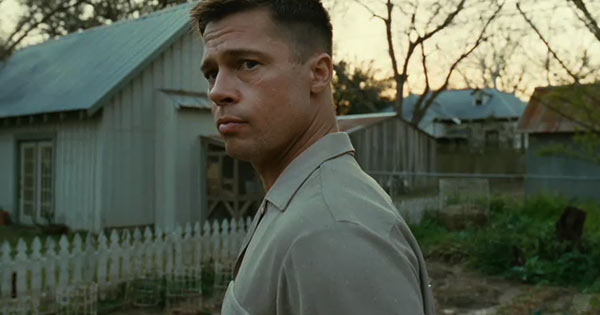
Throughout all of this, the one unifying element is the sheer beauty of it all. Mr. Malick may be influenced by Christianity (the O'Briens are obviously Christian, and the film opens with a quote from the Book of Job), but this is not a religious film. It is a spiritual film, one that seeks to evoke the glory that life holds, without shying away from its moments of sadness and failure. We witness gentle, playful moments with the O'Brien children as toddlers, which gradually become more serious and nuanced as the children begin to experience the darker side of life. Some of it is direct (the oppressive nature of Brad Pitt's Mr. O'Brien), some of it indirect (a young boy who drowns at a swimming pool). All of it, whether simplistic or strange, somehow rings true through Malick's direction, which creates a spiritual experience out of life's most plain rites, rituals, and routines.
And yet all of it is captured with such quiet elegance, thanks to the astoundingly beautiful work by cinematographer Emmanuel Lubezki. The frequent use of handheld camera work bequeaths even the most mundane of scenes with a sense of vitality, even the more abstract scenes involving Mr. Penn's lost wanderings through Houston skyscrapers. And Mr. Malick's impulses, namely subjective shots of nature, have never felt more appropriate or refined in their usage as they have here. When this technique was used in The New World (2005), a film I was not a fan of, I often thought to myself that Malick should have just made a nature documentary. Here, the establishment of the subjective shots, whether they be for the humans or the dinosaurs, carries more purpose, and further illuminates the wonders of life and creation that Malick is trying to capture. The heavy use of voice over, often rambling and tiresome in The New World (and flat-out irritating in Days of Heaven) is now focused and filled with surer purpose than ever before.

But there is still a great deal of heart among all of the beauty, both mundane and otherworldly, to be found here. Mr. Malick may be more interested in using the O'Briens as a focal point for his gargantuan exploration of existence, but the family still comes through as actual characters. Young Jack (Hunter McCraken), carries much of the film, as his transformation from toddler to pre-teen encapsulates the loss of innocence, and understanding of growing up that is so key to this story. Whether the O'Brien boys are playing music, or silently, tearfully mourning the family's need to leave their home, Malick and his actors capture it all through facial cues. Even in the film's finale, perhaps the most difficult portion to make sense of, it's hard to ignore that we're experiencing something of beauty and magnitude, even if we're not entirely sure what it all means.
This is not a film to be explained (though you can certainly give it a shot), but rather one to be experienced. Its length and pacing are occasionally trying, but for a story with so little dialogue, it accomplishes so much more than any number of more verbose films. It's also not a film for everyone, and I'll confess that I was nervous that I would feel the same towards Tree as I did toward The New World. But any way you slice it, Malick's latest remains a massive achievement. Whether you think that it's completely self-conscious, pretentious, and insufferable, or a luminous meditation on the nature of life itself is up for grabs, but you can't know unless you actually see it. The Tree of Life is, more than any film which I've ever described as such, one that deserves to be seen, thought over, and discussed, even if you come to the conclusion that it's all a load of spiritual and philosophical hogwash.

Grade: A-

Monday, May 16, 2011

Cannes Review Round-up: "The Tree of Life"

Arguably the most anticipated title at this year's auteur-filled Cannes line-up, Terrence Malick's The Tree of Life finally received its official premiere. Ever since that stunning trailer was released in December, this has been at the top of my list not just for the summer, but for the whole year. I may not be a complete Malick fan (I love Badlands and The Thin Red Line, but feel pretty 'meh' towards Days of Heaven and The New World), but I certainly respect him as a film maker, and can't wait to see what The Tree of Life holds in store (only two more weeks!). However, Malick's last two films (Line and The New World) have seen the director immerse himself more in his signature style, provoking more divided reactions to his films. If Cannes is any indication, The Tree of Life continues, rather than reverses, this trend:

Rope of Silicon - Brad Brevet: (B) "Just as this film to 40 years took make, it may be another 40 years before I'm ever able to come to a final conclusion on what it entirely means to me."

The Hollywood Reporter - Todd McCarthy: (N/A) "But there are great, heady things here, both obvious and evanescent, more than enough to qualify this as an exceptional and major film." "Emmanuel Lubezki outdoes himself with cinematography of almost unimaginable crispness and luminosity."

Movie Line - Stephanie Zacharek: (N/A) "...strong visuals don't necessarily equal strong visual storytelling. If Malick could tell a story mostly with pictures - and faces - why would he need so many voice-overs?"

The Guardian - Peter Bradshaw: (5/5 stars) "This film is not for everyone, and I will admit I am agnostic about the final sequence..." "...this is visionary cinema on an unashamedly huge scale: cinema that's thinking big."

The Wrap - Sasha Stone: (N/A) "The Tree of Life is saturated with beauty, inside and out."

Indie Wire - Eric Kohn: (A-) "If Lubezki treats his job like a painter, Malick uses his magic to make the artwork come to life."

The Playlist - Kevin Jagernauth: (B) "...the director has once again created a cinematic experience that is uniquely his own, often powerful and mesmerizing, at times overreaching and overbearing, but never forgettable."

Film School Rejects - Simon Gallagher: (C) "Aiming for an experience is one thing, but presenting an intentionally obtuse, impenetrable thing like this is something else entirely."

The Telegraph - Sukhdev Sandhu: (2/4 stars) "Brad Pitt gives the strongest performance of his career, but The Tree of Life is by far the weakest film Terrence Malick has ever made."

InContention.com - Guy Lodge: (3/4 stars) "His most open-armed and structurally undisciplined film to date, it might yet prove his least rewarding."

Variety - Justin Chang: (N/A) "Few American filmmakers are as alive to the splendor of the natural world as Terrence Malick, but even by his standards, The Tree of Life represents something extraordinary."

Additional Comments: Some critics aren't entirely sold on the ending, and feel that it's a bit too literal considering what comes before. Brad Pitt receives almost unanimous praise for his performance, with solid mentions for Jessica Chastain and young actor Hunter McCracken. Even among mixed or negative reviews, critics feel that The Tree of Life is the sort of movie that needs to be seen, if only to determine which side of the debate you fall on.

Cannes Verdict: Undeniably beautiful and complex, and filled with brilliant filmmaking, The Tree of Life is likely to inspire highly divisive reactions, despite its status as a must-see.