Showing posts with label Hugh Jackman. Show all posts

Saturday, March 11, 2017

Review: "Logan"


Director: James Mangold
Runtime: 135 minutes
In Hugh Jackman’s 17-year tenure as Wolverine we have had two Batmans, two Supermans, two Hulks, two James Bonds (the most recent of whom is soon to be done), and now three Spider-Mans. Even Jackman’s co-leads in the X-Men films like Patrick Stewart and Halle Berry have seen other actors play their younger selves. In that span, superhero movies dug themselves out of their graves and burst forth as key priority for the major studios. Before X-Men‘s release in 2000, a sequel (let alone a franchise) was anything but assured. Now, we have interlocking stories being planned and scheduled through the start of the next decade. With all of those seismic shifts, the end of Jackman’s time in his star-making role is momentous in its own way. The character will always outlive the actor, even if that actor is how most envision said character.
The very good news, however, is that this swan song for the Australian actor corrects the mistakes of past X-Men films, while also building on the promise of a previous installment. After the enjoyable but run-of-the-mill X-Men: The Last Stand (2006), the next film in the franchise was a prequel centered on Wolverine’s origins. It came out in 2009, and it was a bit of a mess. Redemption followed with 2013, when James Mangold (Walk the Line, the 2007 3:10 to Yuma remake) helmed The Wolverine, chronicling the clawed mutants exploits in Japan. But The Wolverine‘s success came with an asterisk: it was a big step in the right direction in many way….until the third act, which went heavy on cartoony effects at odds with what came before.
Yet ultimately The Wolverine did enough to pave the way for Logan, so we owe it that much. With Mangold back in the director’s chair, and the freedom of an R-rating, the third time really is the charm for the cigar-chomping anti-hero. It is a Wolverine story that has its own look, its own feel, and despite references to events in other movies, enough narrative confidence to stand on its own.
Opening in 2029, we first meet Logan sleeping in his car, drunk out of his mind. His hair is greying, and his body, though still imposing, looks worn. The character used to be able to heal from nearly all injuries, and now he looks like a man on his last legs. In a world where most mutants have been eradicated (and no new ones have been born), the likes of Logan and Prof. X (Patrick Stewart, also bowing out of the franchise) are relics. They live modest lives, hidden away from general society. No coordinated costumes, no fancy lairs, no custom jets.
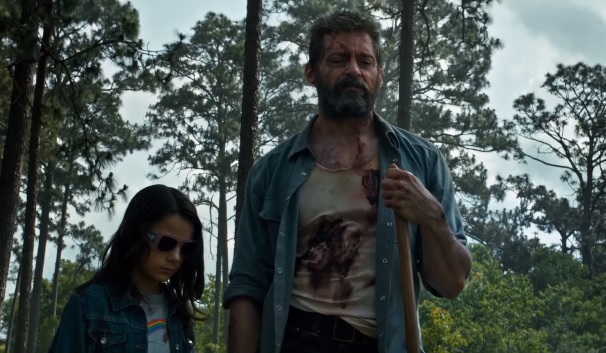

logan2
Dafne Keen and Hugh Jackman

And then along comes a One Last Job opportunity, which our hero reluctantly takes just for the money. At first. The task is to escort a young, “gifted” girl named Laura (Dafne Keen) from the Texas/Mexico up to North Dakota. Naturally, there are obstacles, including a scheming scientist (Richard E. Grant) and a mercenary with a robotic arm (Gone Girl‘s Boyd Holbrook). At its heart, Logan is a Western-tinged road movie, albeit one with a stray few sci-fi elements.
But its also a movie that generally takes as much care with its interpersonal scenes as it does with its carnage. The characters are often on the move, but it’s rare that Mangold’s storytelling feel rushed. This is heightened by the surprising plot structure, which builds to a major moment that could serve as an ending, only to launch immediately into that story’s sequel. But it doesn’t feel jumbled or inelegant. Mangold is in his element here, crafting a story that has its share of action (a vehicular chase is the standout of the first half), but isn’t afraid to throw in the occasional long stretch of quietude.
It’s easy to sneer at idea of a script being a valuable component of a superhero blockbuster, but a good deal of credit belongs to the foundation Mangold and his two co-writers set. Logan takes into account the past stories of the X-Men, while also demythologizing them. In the film’s world, a comic series about the mutants exists, and one key scene involves Logan telling Laura that most of what’s on those brightly-colored panels is bullshit.
But even if the mutant exploits have been exaggerated, they stem from a shred of truth, even if it’s a truth that Logan would rather avoid: he has gifts that he (and others) can use to help the defenseless. That rediscovery is crucial to the character’s development. It’s certainly been done before (perhaps one too many times), but in Logan the arc comes across as a genuine priority, rather than an obligation.
This is never more clear than when looking at the work from the cast. No one’s here to just fool around, pose, and collect a paycheck. The central trio of performances (Jackman, Stewart, Keen) are excellent and unexpectedly moving. For the two gentlemen who have been with these characters from the outset, it’s a chance to bid farewell to a role (and the audience that came with it) with conviction. Wolverine/Logan in his normal state can be one-note. But this figure, who shows actual signs of wear and tear, allows Jackman the chance to put some emotional weight behind the gruff exterior. That the villains are a bit pedestrian ends up not mattering much. The more frightening enemy is the ravages of time, making themselves felt on a character who spent over a century never fearing them. Who knows, maybe Cormac McCarthy ghost wrote a draft of the script.
Logan is undoubtedly striving to be something “adult” and “grounded,” and it succeeds because when it has a chance to go big, it subverts expectations and goes small. Even when Logan goes into full, R-rated berserker mode, it doesn’t last forever or totally save the day. This is a superhero movie with limitations and consequences (many of them involving dismemberment).
The violence and the special effects are there, but they are always in service of a story where violence continuously bequeaths violence, and takes no prisoners (including children) along the way. It is solemn, but with a few flickers of levity to prevent portentousness. There are references to cinematic influences both subtle and overt (at one point several characters watch Shane on TV), but the tributes have been assembled to tell a story that uses familiar settings and tropes to create a tale with its own identity.
Will Logan/Wolverine rise to fight another day, with another face? Almost certainly. With iconic characters like Superman or James Bond, certain faces stick with roles more than others. But new casting does allow for variations on how a noteworthy role is portrayed (contrast Connery’s suaveness with Daniel Craig’s Bourne-like grit) can reflect changes. Few, however, have played a character through so many stylistic evolutions and remained a constant. So, to the person tasked with filling the shoes with nearly 2 decades of work from Jackman, I can only say: good luck; you’ll need it.

Grade: B+/A-

Friday, March 6, 2015

Review: "Chappie"


Director: Neill Blomkamp
Runtime: 120 minutes


Hollywood loves the comfort of formula over the perils of risk. While there's nothing inherently malicious about this mindset, it can, over time, stifle more ambitious ideas and projects. The industry's current state makes a movie like Chappie, the third film from District 9 director Neill Blomkamp, all the more remarkable. Chappie is a film full of knowingly weird elements, from its mix of tones to its casting choices. Yet even though Blomkamp's risks remain admirable, and the film has more of Blomkamp's voice than sophomore effort Elysium, Chappie is an unfortunate instance where almost none of the risks have paid off. Ambition and execution are vastly different things, and, despite a few promising steps in the right direction, Blomkamp is unable to translate the former into the latter.

The world of Chappie, set only a few years in the future, is a return to Blomkamp's District 9 roots. The setting is Johannesburg, and technological advances are few and far between. This time, however, the sci-fi pieces of the story stem not from alien refugees, but from man-made devices. Seeking to cut down on crime rates (as well as officer fatalities), South Africa implements the world's first robotic police force, courtesy of the Tetra Vaal corporation, headed by Michelle Bradley (Sigourney Weaver). Lead programmer Deon Wilson (Dev Patel) is the true star of the company, and is doing his best to push the robots even further: he wants to create a truly sentient robot, capable of emotions and opinions. He even has a malfunctioning police robot that would be perfect to test his new program on. Bradley is dismissive of the idea, as is co-worker (and former soldier) Vincent Moore (Hugh Jackman), who has a near-religious fear of AI. With its corporate overlords and security state parallels, Chappie lays out a basic foundation that one expects of this sort of sci-fi adventure. And then the rappers step in. 

Though one of the film's eventual protagonists is the titular robot (created via motion capture with actor Sharlto Copley), the biggest casting risk found in Chappie is the use of South African rap-rave duo Die Antwoord. Members Yolandi Visser and Ninja play fictionalized (and gangsta-ized) versions of their stage personas, and they represent Chappie biggest gamble (yes, moreso than forcing Jackman to sport a mullet from hell). Everything about them is attention-grabbing, from their speaking voices to their decorative instincts (the duo's lair appears to have been marked up with a mix of chalk and highlighters). In essence, they look like extras from a Mad Max film by way of an episode of Wacky Races. The pair hijacks Deon's truck (with the future Chappie in tow), and steal the droid in an attempt to hack the system (the "off switch" for the police bots is kept in a heavily-guarded vault). Given the nature of Deon's program, Chappie starts out with the robot equivalent of a toddler's capabilities. 

Chappie's childlike personality informs the central conflict of the story, which sees Deon, Yolandi, and Ninja all trying to raise the droid in different ways. While Deon and (surprisingly) Yolandi are gentle, Ninja has no patience for the creature's infantile first phases. Had Blomkamp and co-writer Teri Tatchell honed in on the story's family of freaky outsiders, Chappie might have built to something genuinely resonant. Instead, the scattershot script is constantly interrupting Chappie's growth with not one, but two completely separate villains. In addition to Jackman's increasingly unhinged Vincent, Blomkamp also insists on holding onto local gang lord Hippo (Brandon Auret), to whom Yolandi and Ninja owe millions of dollars.

With so much crammed in, Chappie is narratively overstuffed, even at two hours. Just as Yolandi and Ninja clash when it comes to how to raise their titanium-coated child, Blomkamp and Tatchell struggle to streamline the various pieces of the story into a coherent final product. There's little change in the filmmaking when Blomkamp tries to inject some odd-ball black comedy, and then switch to what should be a more introspective moment. The pacing is monotonous, leaving the smaller moments - such as a damaged and heart-broken Chappie finding companionship with a stray dog - without room to take hold. With sharper scripting and more varied direction, Chappie could have conjured up some moments of WALL-E-type grace, albeit with a bizarro, R-rated edge. Instead, these potentially affecting moments move along as if they're being rolled off of an assembly line, just like the rest of the film.

Mr. Copley, who has had a major role in all of Blomkamp's work to date, is hurt most of all by the film's failings. The heart and soul of the character never has a fighting chance against the suffocating, increasingly stupid escalation of the plot. As is to be expected, Blomkamp's ability to come up with designs for robots, weapons, vehicles, but his filmmaking robs Chappie and Copley of the opportunity to create something on the same level as Andy Serkis' creations in The Lord of the Rings or Planet of the Apes. Copley has turned in a few truly bad performances since District 9, but when working with Blomkamp, the actor is in his element. If only the director had given him the attention he deserved here.

Other performances unremarkable, and, like Copley, are let down by both the writing and direction. Patel comes closest to giving a legitimately good performance. In his interactions with Chappie, Patel brings a lot of heart to Deon, the only person who has the robot's best interests in mind from the very start. Jackman has fun playing a villain, but all of his scenes are reliant on the same one-note menace. Weaver, no stranger to making her mark in science fiction, is utterly wasted in what basically amounts to a glorified cameo. 

Yet even though Chappie is the would-be heart of the story, nothing better encapsulates the experience of Chappie the film like Die Antwoord. Though neither have acting experience, the duo's freaky, theatrical performance styles aren't an entirely bad match for the screen. But, in keeping with everyone else, Yolandi and Ninja are flat, one-note characters (that Ninja is nothing but a jackass until the final minutes doesn't help at all). Their top-to-bottom weirdness is curious and refreshing at first, and lends the film a distinctly South African stamp. But in the context of Blomkamp's repetitive, at times incoherent, filmmaking, even the allure of their unique identities feels worn out by the end. Weirdness for the sake of weirdness can produce arresting results (e.g. the best work of David Lynch), but when said weirdness is filtered through increasingly routine blockbuster chaos, it winds up as intellectually and emotionally hollow as most of the robots on screen.

Grade: C-

Saturday, May 24, 2014

Review: "X-Men: Days of Future Past"


Director: Bryan Singer
Runtime: 131 minutes

At once a sequel, prequel, and complete narrative overhaul, Marvel's X-Men: Days of Future Past certainly hasn't been shy about its ambitions. With casts from the original trilogy and 2011's First Class, returning director Bryan Singer, along with a plot involving time travel, Days of Future Past seemed like an unwieldy entity. After leaving the X-Men franchise to direct the leaden Superman Returns and the flat Valkyrie, Singer's return to the director's chair was understandably met with hesitation. Yet he and writer Simon Kinberg (atoning for the mostly awful X-Men: The Last Stand) have avoided running Marvel's prized mutant family into the ground. While the franchises of the various Avengers heroes are clearly Marvel's top priority, Days of Future Past returns the X-Men to their glory days. This is more than a step in the right direction. It's a full-blown resurrection, with plot, spectacle, and drama all skillfully woven together. 

This is most impressive when considering the important of time travel to DOFP's narrative. There are always plot holes that crop up when time travel arrives in a story, so it's important to manage everything else smoothly enough so the stakes get more focus than potential story-telling paradoxes. Singer, clearly reinvigorated by returning to this world, shows that he knows how to handle this world better than those peers that have sat in during his absence. Working off of Kinberg's smooth, straightforward screenplay, Singer and editor/composer John Ottman are able to keep things moving along beautifully, without every leaving key characters in the dust. 

That last bit is of special importance in this film more than any other X-Men adventure. Though we see plenty of mutants across the 131 minute duration, many are just there to fill the screen. Don't expect to learn more about the likes of Warpath (Booboo Stewart) or Fan BingBing's portal-creating Blink. They, along with several others, are just here to fill out the story's framing device which is this (take a deep breath): After Mystique (Jennifer Lawrence) kills anti-mutant scientist Boliver Trask (Peter Dinklage), the world's governments pour money into Trask's Sentinel Program. The Sentinels are large, adaptable robots that, a la Skynet, eradicate mutants and their genetically mundane allies. With the future now a bleak dystopia, Prof. X (Patrick Stewart) and Magneto (Ian McKellan) come up with a last ditch plan. With help from Kitty Pryde (Ellen Page), they will send Wolverine (Hugh Jackman) into the past to reunite the young Xavier and Magneto (James McAvoy and Michael Fassbender, respectively) to stop Mystique's mission, as well as its increasingly devastating consequences.

Once all of the time-travel mumbo jumbo is hashed out via's Stewart's effortlessly commanding voice, and Wolverine wakes up inhabiting his body as it was in 1973, the film really comes to life. Despite all of the VFX involved, Days of Future Past is never careless when it comes to digital trickery. The story and the quartet of Jackman, McAvoy, Lawrence, and Fassbender are the real draws here, and Kinberg gives each role enough room to breathe. While it's frustrating to see Page's role hollowed out (in the source material, she was the one who leapt back in time), the story's four leads and their various conflicts are still compelling. 

Rather than retread old ground, the first half of the film plays like an inversion of the very first X-Men (2000). Here, Wolverine has to step back and be both mediator and leader, roles he was in no way ready to take on when he first joined the X-Men. Meanwhile, young Charles Xavier is a depressed, alcoholic mess who has lost his way. Beast (Nicholas Hoult) has healed Xavier's legs, but the cost has been his tremendous psionic powers. Even though Wolverine is able to make Xavier believe his outrageous time travel story, the latter hardly feels like reconnecting with his mutant roots.

Though Jackman's Wolverine has always been a central part of the X-Men movies, his role reversal is a smart choice, and he and McAvoy play off of each other quite well. There are still traces of the cynical mutant's past in Jackman's performance, but here they're held back for the sake of urgency. McAvoy, meanwhile improves on his already impressive performance from First Class as the film's mentally shattered version of Xavier. The actor's vulnerability and desperation are given the weight needed to make us care, without digging so deep as to turn the film into a pretentious existential drama. 

Things only get better as Fassbender and Lawrence enter the fray. The former remains perfectly suited as the dogmatic Magneto, while Lawrence brings more genuine spark to Mystique than she did in First Class, where she was occasionally flat. Special mention should go to Evan Peters as the ultra fast Quicksilver, who is given just enough to be an enjoyable addition without leaving the film overstuffed. His part in the story is brief, but critical, and it allows Singer and co. to use Quicksilver's powers as part of the film's lightest, most enjoyable set-piece. Unlike the extra mutants in X-Men Origins: Wolverine, Quicksilver's guest appearance here is superbly integrated, and it ends just in time to get back to the four established protagonists.

Every one of them has an agenda, yet the streamlined plotting ensures that motives remain clear without grinding the film to a halt. Days of Future Past is always moving, yet it never feels rushed outside of the exposition-heavy opening. The blockbuster it best calls to mind (and not simply because of the time travel aspect), is the 2009 reboot of Star Trek. The JJ Abrams film had a lot going on, yet kept its characters grounded amid all of the flashy effects to deliver an experience where the drama was earned, and therefore resonated. 

Backing up Singer's handling of the story and his main stars are some of his slickest, liveliest direction to date. Eschewing the rather bland color palette of most Marvel films, Days of Future Past is much more visually engaging than the standard summer tentpole. Newton Thomas Siegel's photography, especially in the 1973 scenes, is rich and textured, and lends an extra bit of believability to the fantastical premise and characters. He and Singer also have a bit of fun capturing some of the mutant action on 70s era cameras, further grounding us in a time period where the mutants stand out even more than they do in the present or future. Production designer John Mhyre, whose stacked resume includes superhero flicks and glittery musicals, does a stellar job with sets without going overboard.  

And then, of course, there are the visual effects. Though some elements are more cartoon-y than others (the future versions of the Sentinels), most of the VFX work is superbly handled. It only ups the stakes and the grandeur, rather than taking focus away from the story and characters. Even in the finale, which is filled with some truly massive effects (as well as hefty cross-cutting between past and future), the story's over-the-top emotional core stays front and center. 

Like last month's Captain America: The Winter Soldier, Days of Future Past succeeds because it bucks two major trends found in big-budget spectacles: being overly glib so that no drama interrupts the spectacle, or trying so desperately to be dramatic that all fun is squeezed out. Though Days of Future Past does reset the chessboard for the franchise, it still works as its own self-contained (albeit open-ended) adventure, one with an engaging story and engaging characters worth following. What could have been a jumbled, incoherent mess is, thankfully, one of the most assured and accomplished superhero films to date. As much as the franchise has stumbled over the past few years, Days of Future Past shows that when they're on their A-game, the X-Men are among the best in the business.

Grade: B+

Saturday, September 21, 2013

Review: "Prisoners"


Director: Denis Villeneuve
Runtime: 153 minutes

You'll have to look awfully hard to find anything new in a film like Prisoners, the English language debut of Quebec-born filmmaker Denis Villeneuve. As written by Aaron Guzikowski, the film's tale of two missing girls and the search to find them covers its share of well-worn tropes, many of which can be found on one of the many police procedurals currently on TV. Yet thanks to superlative craftsmanship, effective plotting, and top flight performances, Prisoners rises above the average procedural, even though it never quite transcends the genre to achieve true greatness.

As the film opens, we see hear Keller Dover (Hugh Jackman) reciting the Lord's Prayer as he and his son lie in wait for a deer to shoot. This immediate juxtaposition of faith and violence (on an innocent subject, no less) will echo throughout the film's tale of desperation, loss, and vigilante justice. On an overcast Thanksgiving Day, the youngest children of the Dovers (Jackman and Maria Bello) and the Birches (Terrence Howard and Viola Davis) go missing. Though twitchy Detective Loki (Jake Gyllenhaal) quickly finds  potential suspect Alex Jones (Paul Dano), the hunt for the girls has just begun. Frustrated with the police department's inability to find strong evidence, Keller takes matters into his own hands.

All of this takes up no more than the film's first 40 minutes, leaving roughly 110 more. Yet rather than cram the remaining runtime with twists and red herrings, Prisoners finds a smart, and even surprising, balance between the mystery driving the narrative forward, and the character drama that holds it all together. While this makes the narrative less immediately compelling, it allows Prisoners to explore its characters and the repercussions of their actions without having to rush. Rather than try to pull off something we've never seen before, the film simply takes familiar ingredients and executes them with a very sure hand. 

There's also the matter of the effort that's been put into the film's look, which does its best to distance itself from the small screen as possible. With its gloomy visual aesthetic and haunting flares of music, Prisoners owes as much to the crime thrillers of David Fincher as it does to TV dramas like Broadchurch and The Killing. Where the film receives a considerable boost is in the lensing from master cinematographer Roger Deakins. With its rainy, wintery suburban settings, there appears to be little room for a movie like Prisoners to have any visual flair. Yet Deakins, with all cylinders firing from start to finish, finds ways of capturing the dreary and plain settings with a level of artistry that feels wholly cinematic, yet never pretentious or distracting.

The cast certainly aren't shirking their duties either. Stacked with talent in every major role, the entire ensemble gives it their all. Even Bello and Davis, whose characters are somewhat underutilized, have moments that they knock out of the park. Dano is effective as well as the mumbly Alex, while Melissa Leo underplays her ambiguous role as the boy's doddering aunt. Of the supporting roster, however, it's Howard who makes the strongest impression. Some of that is due to how the script uses the character, but the actor finds ways of communicating grief and confusion without ever being redundant. As one of the cast members who spends the most time playing off of Jackman, Howard makes his straightforward character a nicely conflicted foil. 

Where the acting really shines, however, is in the leading duo of Jackman and Gyllenhaal. The roles are radically different, yet the way they reflect the dual strands of Prisoners' narrative creates a compelling blend of material driven by pure emotion and by pure clinical determination. Jackman, coming off of a career high with Les Miserables, has the emotional side of the story to carry, and the ferocity he brings to the role is never less than gripping. For all of the hysterical yelling involved, the actor never sounds shrill or false. It may not be subtle work, but Jackman invests each growl and yell with a fury that would make even Wolverine cower. On the opposite end of the spectrum is Gyllenhaal, who makes the less emotive role work in his favor. He puts a nervous bit of blinking, though initially distracting, to smart use as a means of communicating the character's internal processing of events.

Behind the scenes, Villeneuve deserves immense credit for his intelligent balance between the emotional and the procedural elements of the story. His previous film, 2010's Oscar-nominated Incendies, marked him as a talent to watch. Though more harrowing than Prisoners, that film also suffered from a messiness that built to a pair of twists that bordered on laughable. Prisoners runs nearly 15 minutes longer than Incendies, but it feels remarkably more focused, despite the room it allows for slow-building drama. Procedural mysteries live or die by how well they pull you in. Even the best of the genre, such as The Silence of the Lambs and Seven, have their implausibilities upon reflection. Yet what makes a great procedural work is its ability to cast a strong enough spell to allow you to suspend your sense of disbelief. Following in the footsteps of those aforementioned films, Prisoners certainly succeeds on that level, albeit with less flash (you'll find no lip-smacking cannibals). 

The lone disappointment of Prisoners, however, stems from the very aspect of its script that also makes it a success. By aiming for character-based drama over thrills, the film starts to feel more generic as a whole, despite the first rate filmmaking. There's a tantalizing taste of the more ambitious, possibly pulpier, movie that could have been made in the form of a mysterious maze symbol. You can practically feel Guzikowski contemplating whether or not to take said symbol and use it to turn Prisoners into a denser and more twisted story. Instead, the resolution of the maze, and the main plot, comes across as rather expected, even though it's as well-crafted as everything that precedes it. 

In straddling the line between thoughtful character drama and attention-grabbing thriller, Prisoners somewhat robs itself of a sharper identity. In trying to focus more on emotional developments, the film forgets to give itself a memorable stamp. Not content to end with a whimper, however, Prisoners ends (and the sound team deserves kudos here) its somewhat mundane narrative with a brilliant piece of ambiguity. Just when it seems in danger of fading out forgettably, it throws in one last nasty little kick that ensures that it'll stay with you just a little bit longer (Law and Order looks cheerful in comparison). It may not be the next Zodiac, but Prisoners is still an compelling and satisfying mystery with a refreshingly adult look at unsettling subject matter. 

Grade: B+

Friday, July 26, 2013

Review: "The Wolverine"


Director: James Mangold
Runtime: 126 minutes

In an age when superheroes dominate the summer with all manner of spectacle, there is something shockingly intimate about James Mangold's The Wolverine. Where the last standalone Wolverine movie was a jumbled, incoherent  mess, this one latches onto a single story and dives in headfirst. The number of mutants and flashy superpowers is kept to a minimum, and there's hardly a cheesy costume in sight. It makes sense that the word X-Men was taken out of the title for this latest enterprise, which is barely a superhero or action movie at all. The Wolverine is not without its flaws, but its modest ambitions and aversion to city-leveling chaos do produce some pleasing character-driven moments along the way.

There is, actually, a city that gets destroyed in The Wolverine, but it's not part of any titanic battle between mutants. Rather, it's the dropping of the atomic bomb on the city of Nagasaki, where Logan/Wolverine (Hugh Jackman) is being held as a POW at a Japanese military prison. As he hides from the nuclear blast, he ends up saving Japanese soldier Yashida (Ken Yamamura). Years later, an aging Yashida (Hal Yamanouchi) calls on Logan via his aid Yukio (Rila Fukushima). Yet when Yukio finally finds the Wolverine, he's a shadow of himself. Still grappling with the events of X-Men: The Last Stand, Logan has let himself go (as much as his enhanced musculature will let him, that is). He looks like an unkempt mountain man, and largely avoids society and mutant heroics at any cost. 

And it's with very little enthusiasm that Logan goes with Yukio to Japan. Once there, he gets cleaned up, and learns that the old Yashida may be able to cure him of his immortality, allowing him to finally grow old and die. Of course, sinister forces are at work, and soon Logan is sucked into familial and political drama involving Yashida's son Shingen (Hiroyuki Sanada) and granddaughter Mariko (Tao Okamoto). Rather than get straight to the slicing, shooting, and stabbing, this film is content to take its time as it builds a pulpy mystery of a plot.

It takes roughly half an hour before the first action sequence arrives in the film, and it's not the most satisfying from a visual standpoint. Some of the editing is choppy and obscures the choreography. Yet even as I was somewhat frustrated by how some of the action was stitched together, I realized that I still found myself engaged with the material, and caring about what was going on. The script, from Mark Bomback and Scott Frank, has enough economical character work that you have reason to care about what's happening. 

More than any superhero film in recent years, The Wolverine is more content to act as a character piece. Each action sequence actually propels the narrative forward, and the scale is never magnified for the sake of creating unnecessary spectacle. Yes, the climactic showdown does take a cartoony left turn, but with the first two acts so effectively assembled, the sins of the last chunk of the story are largely forgivable. 

What the film lacks is simply any sort of stylistic stamp to heighten its positive qualities further. Darren Aronofsky was once attached to direct, way back in 2011. As many good things as Mangold brings to the table as a director, one can't help but wonder about the film that might have been under Aronofsky's guidance. To his credit, however, Mangold does make the film feel quite grounded, especially in the early stretches. He also pulls off a hugely enjoyable fight scene set atop a speeding bullet train, which has a certain disregard for physics yet feels completely in line with this more toned down aesthetic. 

And, as mentioned before, the film also keeps one engaged because of its dedication to character work. Jackman could easily play this role on autopilot by now, but the actor seems reinvigorated here. There are new shades of grief and exhaustion brought out by the plot, meaning that there's more for him to do than scowl and project sarcastic indifference. In fact, this film may contain the actor's best work as the X-Men's most famous member. The supporting Japanese cast are also quite enjoyable. Fukushima's red-haired Yukio has a fun dynamic with Wolverine that suggests a more hesitant Batman and Robin pairing. Even with Wolverine's existential gloom and doom, his partnership with Yukio creates some levity, and ensures that the film is never drowning in self-seriousness. Tao Okamato also handles her role quite well, and she's served quite nicely by the script. She may be in need of some rescuing at the end, but she's also been written as a smart and compassionate character who can throw a few punches and stabs when needed. 

Even Svetlana Khodchenkova (Tinker Tailor Soldier Spy) as slinky femme fatale Viper is a great deal of fun. The film may shortchange her by not giving an ounce of time to her motivation or background, but the actress' vamping is tempered so as not to distract. She's a sign of the lingering cartoonishness of the X-Men world, but compared to other characters in the franchise's cinematic universe, she feels quite tame. That's one of the most interesting things about The Wolverine: aside from Jackman, the women are the ones who really dominate the screen, which makes for a nice change of pace in a genre overrun with testosterone. 

With X-Men: Days of Future Past, set to hit theaters next summer, there's a little bit of tension sapped from The Wolverine, knowing that the famed mutant has to survive in some capacity. And as spectacle, The Wolverine has only one noteworthy sequence (and honestly, I wanted the bullet train bit to go on much longer). But through all of the ordinariness of the film there remains an immense appeal in Jackman's version of the character. Here, he comes off as a gruffer and less polished Bond figure, and that's quite a good thing. The Wolverine may not be the great standalone Wolverine film that it once could have been. Yet in a summer filled with exhausting visual excess, there is something ultimately winning about a movie that pushes superhero theatrics to the side in favor of moody character drama for as long as it can, before the demands of the summer blockbuster come crashing in. And even then, Mangold's film remains remarkably small and focused in ambition and execution. The film may not have enough to make itself essential viewing, but it's worth checking out if only because of how effortlessly it works against being just another superhero movie.

Grade: B-

Wednesday, December 26, 2012

Review: "Les Miserables"


Director: Tom Hooper
Runtime: 157 minutes

For as BIG as Tom Hooper's Les Miserables is - the music, the decades-spanning story, the emotions - this adaptation of the mega-musical also contains a surprising intimacy. Aside from the decision to shoot the musical numbers live/on-camera, no one directing aspect has received as much attention as Mr. Hooper's close-ups on his actors' faces. It's a decision that, like much of the material on display here, will likely prove divisive (not to mention the fact that the film is almost entirely sung, even outside of standard songs). As someone completely unfamiliar with the stage show as a whole (I know a few songs and some major plot points), I had reason to fear for the worst. Yet, some missteps that arise in the middle sections aside, Hooper's film soared enough to turn me into a Les Mis convert. 

As far as plot goes, there's quite a bit (which is at times a slight problem). The basics are as follows: Jean Valjean (Hugh Jackman), released on parole after 19 years in prison, seeks to rebuild his life while avoiding the unwavering lawman Javert (Russell Crowe). There's also a wrongfully disgraced factory worker (Anne Hathaway) and her daughter (Isabelle Allen/Amanda Seyfried), a band of student revolutionaries (Eddie Redmayne, Aaron Tveit), and a pair of nefarious inn-keepers (Sacha Baron Cohen and Helena Bonham Carter). Even at 2 hours and 40 minutes, the show (and as a result, the film) wobbles when it comes to condensing Victor Hugo's mammoth novel. Thankfully, there's a game cast delivering some rousing renditions of the epic score. Ultimately, how you feel about Les Miserables could come down to the music. If the musical material isn't working for you (ballads, sung-dialogue, etc...), then it might be best to leave early on. 

But not too early. Because at the very least it's worth staying around for what will inevitably become the film's signature moment: Anne Hathaway's rendition of "I Dreamed a Dream." Though the scene's power in comparison to others has been overstated, this is the scene that will likely win over the hardest hearts, even if said hearts hate everything else the film has to offer. Hathaway's time as Fantine is brief, but she nails what little material she has, turning her doomed character into a suitable icon to loom over Valjean for the remainder of the story. Watching Hathaway's big moment highlights all that works in Les Mis, and how the soaring moments overcome the smaller missteps. Yet to cite "I Dreamed a Dream" as the sole shining moment of the film does a disservice to so many other moments.

Carrying the bulk of the narrative is Jackman's Jean Valjean. Though his songs are some of the least melodically compelling, the actor compensates by marvelously acting through them. One of his earliest moments, the expositional "Soliloquoy," pales in comparison to nearly every song, yet succeeds thanks to Jackman's ferocious commitment. Jackman blasts through the screen as Hooper and cinematographer Danny Cohen hone the camera in on his face, allowing himself to falter with words, his voice breaking on carefully chosen words to bring a sense of character to the discordant music. Jackman is forced to stick to his upper register, where his voice starts to veer towards shrillness, but the power he brings to the numbers remains compelling. 

The rest of the cast fare equally well, even though some have less material to work with. Eddie Redmayne, among the cast's stronger vocalists, makes the potentially bland Marius an engaging presence. His work opposite his fellow student rebels (led by a magnetic Aaron Tveit as Enjolras) resonates, and his one time to shine as a soloist reaches the same emotional magnificence of Fantine's anguished cry in the dark. His pair of romantic interests handle themselves well, even as the material lets them down compared to the ensemble. Amanda Seyfried does her best to turn adult Cosette into a compelling presence, but ultimately the role doesn't have quite enough weight to it. Then there's Samantha Barks' Eponine, who sings quite well, but lacks the screen presence of those around her.

Less immediately entertaining are the story's comedic relief cast members, the nefarious Thenardiers (Cohen and Bonham Carter). For those not acquainted with the material, the Thenardiers' "Master of the House" could prove awkwardly stitched together and jarring, considering the material that comes before. The Thenardiers' presence is something of a mixed bag throughout, and the might have better served the film with fewer, more carefully chosen, scenes. 

Last, but not least, is Russell Crowe as Valjean's tireless nemesis, Inspector Javert. Crowe has become the single most divisive element of the cast, yet I have to confess that I found the actor compelling, despite his thinner vocals. Crowe's limited range fits into an interesting rock opera range, yet thanks to the close-ups, he's able to make it work. Both of Javert's big solos, vocal rough patches and all, managed to give me the right kind of chills. Redmayne is the vocal star of the supporting cast, but as far as acting is concerned, it is Crowe who truly makes every moment count. 

With the cast generally turning in strong work, however, there's still the matter of everything around them. And thankfully, despite some shortcomings, Hooper and his behind the scenes collaborators have brought their A game. The cinematography, wide angle lenses and all, gives the songs a sense of immediacy. These are not the prettiest renditions of the score, yet thanks to the use of close-ups, they are guided from their lofty pedestals down to a much more human and visceral level. And Cohen's camera also captures the often dark scenes with a surprising richness, and the scenes set in daylight possess a painterly texture that fits wonderfully with the time period. Technical aspects, despite the inherent dreariness of the setting, are also aces. The stylized sets and costumes are bold and textured, and the makeup ranges from wonderfully subtle (Valjean's aging) to appropriately cartoonish (Mme Thenardier in particular).


Yet for all that Mr. Hooper gets right as a director, he does make some decisions that get in the way of his cast, rather than helping them. Given the magnetism of the performances, Hooper's framing can be overlooked. Less forgivable is his staging of certain numbers, which isn't helped by the occasionally fussy editing. It's going too far to say that the film succeeds in spite of Hooper's direction, but some of his choices do provide some unnecessary hurdles. However, Hooper does allow the camera to settle in enough places to create some stirring (and stable) imagery. 

And when Les Miserables soars, it does so magnificently. The songs of the student rebels are among the most rousing, and lend the film a new sense of energy as new characters and arcs are introduced. Even when characters appear  as though the entire cast was living in a shrunken version of Paris, the music's power in the hands of the ensemble remains undeniable. The richness and grandeur of this musical epic remain fully intact, despite the deliberately unpolished vocals. Whether you weep or find yourself lifted in triumph, Hooper's shamelessly epic treatment of the material, coupled with the bracingly intimate treatment of the performances, manages to rise to the occasion over the technical bumps in the road. It may take some time to adjust (I have seen the film twice now), but even for the uninitiated, there is potential for this extremely faithful version to win you over. Or, at the very least, you can hear the people sing, and hopefully like some of what you hear. Les Miserables is full throttle in its sincerity (there's no Sweeney Todd-style black comedy) and devotion to the musical/operetta form. As such, it will undeniably turn off plenty, whether they be those driven away by the music, or Hooper's direction. Yet for those with whom the film even partially connects, there will be moments that register with a level of old fashioned majesty that's worth singing about.

Grade: B+/A-

Thursday, March 18, 2010

Oh Hugh Jackman, you dirty racist

Keeping racism classy

So, only hours (or a day?) after solid news from Lee Daniels' Selma emerges, we finally learn Hugh Jackman's role. The first (I think) confirmed member of the cast, he was a bit of a surprise choice considering that he's a big star and well, the central characters are black. Well, for those of you who placed bets that Mr. Australia would play MLK, very funny, and no. Hopefully this will be another The Fountain for Jackman, or perhaps even better. To see him play a thoroughly unsympathetic character? Actually, I can't wait:

Source: CinemaBlend
It was a little strange to learn that Hugh Jackman was the first official cast member of Lee Daniels' historical film Selma, given that it focuses on Martin Luther King Jr. and President Lyndon Johnson and their roles in the 1965 Civil Rights March. I mean, Jackman wasn't going to be playing either of those characters, right? Um, right?

Now Wolverine himself has stepped in to explain things, and yes, he is definitely playing an appropriate role. He'll play Jim Clark, an Alabama sheriff who violently arrested several of the marchers, as he told Vulture. Given that he knew he probably wasn't supposed to admit even that-- "that's enough trouble for one night," he told them-- he declined to explain any further. But Clark's Wikipedia page notes that he was responsible for "Bloody Sunday," in which he ordered his mounted police to charge a group of peaceful protesters. A year before his death in 2007, he told a local newspaper he'd do the same thing again if given the chance. Sounds like a fascinating, brutal guy, and a big change of pace for the sunny and well-liked Jackman.

All of Daniels' Men...minus De Niro...maybe(?)


If there's one thing we learned from Precious, it's that Lee Daniels can make a comedian, a newcomer, and a singer give great performances. Considering the results on Precious, I can't wait to see how he does with trained actors (and a singer). The subject matter is always interesting, and the description of Selma doesn't sound like a by-the-numbers biopic, but rather an interesting look at significant figures in the Selma race riots and beyond. Lenny Kravitz did a nice job in Precious, so it will be interesting to see his take on a (presumably) larger role. And of course there's the Martin Luther King Jr. factor; a compelling take on the great civil rights leader could make for a stunning film. The most exciting part? Another opportunity to see triple threat Hugh Jackman take on some heavy material again. Because of his great looks and physique, there's an unfortunate tendency for Jackman to be cast as an action hero (how much of it is of his own volition, I don't know), and we don't get to see the deeper (read: better) side of his acting talents, save for The Fountain, which was too divisive and which no one saw. Always a charismatic performer, I'm really excited to see what happens with Jackman under Daniels' guidance. Maybe a chance at that long-awaited first Oscar nomination? A chance for Daniels' second nomination?

Source: FirstShowing
March 17, 2010
by Ethan Anderton


After adding Lenny Kravitz and confirming Hugh Jackman taking on a role in his civil rights film Selma, THR reports that Oscar nominated director Lee Daniels has finally found his Martin Luther King Jr. in actor David Oyelowo (The Last King of Scotland, Red Tails). King was one of the key characters waiting to be cast in a story that revolves around the historic marches led by MLK in 1965 in Selma, AL. However, it looks like there's a chance that the thought to be confirmed involvement of Robert De Niro may not be official, as a blurb in the trade says: "The part of Alabama Gov. George Wallace remains up for grabs." Wait, really?
You would think that Daniels saying that De Niro would be in the film was official enough, but maybe a deal hasn't been finalized prompting THR not to count their chickens before they're cast (which is a smart move these days). I guess we'll have to wait and see how this turns out and if anymore official word makes its way to the media. We're still waiting to hear who will play Lyndon B. Johnson as well, who plays a very pivotal part in the story, so surely there are more casting confirmations on the way. In the meantime, let's hope that Daniels does land De Niro as Governor Wallace, because that really seems like inspired casting.

Wednesday, November 26, 2008

Australia - REVIEW


One of the easiest observations one can make about "Australia" is that they don't quite make them like this any more. "Australia" is above all things, old fashioned (lines between good and evil are drawn clearly, the bad guy has no redeeming qualities, etc...) and un-apologetically so. It is truly the epitome of the "sweeping" romance genre that has just about died out, where things are painted in broad strokes, and where the plot continues to stretch on and on, and you sometimes wish that it would keep going. Granted, it's not up to par with Baz Luhrmann's musical acid-trip, "Moulin Rouge!", but it has its share of brilliance, albeit in a less over-the-top/theatrical manner. Many scenes have a layered look, where backgrounds look less real than foregrounds, so as to create a sort of fairy-tale-pop-up-book look. At times it can be a little distracting, especially in a heart-pounding cattle stampede in the first act, but luckily it never completely derails the movie. At its center is the relationship between English aristocrat Lady Sarah Ashley (Kidman), ranchhand The Drover (Jackman), and a mysterious aboriginee boy named Nullah (Brandon Walters, making a lovely acting debut). Predictably, Drover and Sarah start off quarreling (some of it with hilarious results), but eventually begin to fall for each other. Sounds predictable enough, right? And this is where the magic of Mr. Luhrmann comes into play. Just like with "Moulin Rouge", Mr. Luhrmann takes the type of story that we've seen done a million times, and manages to tell it in a refreshing way that stands out. Perhaps most unique (and most charming) is the way that "The Wizard of Oz" is woven into the plot, for results ranging from comical (Sarah trying to sing "Somewhere Over the Rainbow" to Nullah) to charming (Nullah actually getting to see "Oz") to haunting (a fusion of "Somewhere Over the Rainbow" and "Ave Maria"). If it sounds corny, it surprisingly isn't, and the little references and musical flourishes dedicated to "The Wizard of Oz" don't feel forced, but rather flow seamlessly with the story. Yet perhaps the biggest surprise in all of "Australia" is its sense of humor. The first third of the film is where 95% of the humor is, and some of it is gold. Watch out for a purposefully over-the-top scene with Lady Ashley getting overly excited about the site of kangaroos, that takes a rather odd turn (and one that gives Kidman the chance to tap into her often neglected comedic prowess). Though this is neither her best performance nor the most memorable character in her career, Kidman still manages to turn a cardboard cut out of a character and make Lady Ashley a living, breathing, person. Jackman, though not quite as nuanced, proves that he's one of the few actors out there who can pull off the rough-hewn leading man role with plenty of charisma and charm, while Walters exudes charm and innocence as Nullah. David Wenham makes good as the loathsome villain, along with David Gulpilil as an old mystic who guides Nullah on his spiritual journey from afar. Cinematography, while not as beautifully oversaturated as "Moulin Rouge", is still wonderful and manages to capture the Outback's more rugged beauty, while costumes and sets look grand. Tying it all together is David Hirschfelder's score, which pounds away to great effect, even bringing in a screeching choir during the brief-but-spectacular Darwin bombing sequence. Part opposites-attract love story, part western adventure, part spiritual fairy tale, and part somber war tale, "Australia" was a truly gargantuan undertaking for a director who has previously relied on stories confined to a smaller stage. Australia the continent provides Luhrmann with the biggest stage possible, and its history, its culture, its people, and, well, its actors, all serve him beautifully, and Mr. Luhrmann proves that he is the cinematic wizard of that strange and beautiful continent down under.

Grade: A

Nominations: Best Picture(#2), Best Director - Baz Luhrmann(#2), Best Actor - Hugh Jackman(#3), Best Actress - Nicole Kidman(#2), Best Supporting Actor - Brandon Walters(#4), Best Original Screenplay(#1 WINNER), Best Editing(#2), Best Cinematography(#1 WINNER), Best Art Direction(#1 WINNER), Best Costume Design(#1 WINNER), Best Original Score - David Hirshfelder(#1 WINNER), Best Original Song - The Drover by Elton John(#4), Best Makeup(#1 WINNER), Best Visual Effects(#3), Best Sound Editing(#2), Best Sound Mixing(#2)

Number of 2008 Films Seen: 42

Top 10 of the Year:
1. The Dark Knight
2. Australia
3. WALL-E
4. In Bruges
5. Burn After Reading
6. The Fall
7. Vicky Cristina Barcelona
8. I've Loved You So Long
9. The Duchess
10. Rachel Getting Married