Showing posts with label Mia Wasikowska. Show all posts

Saturday, October 17, 2015

Review: "Crimson Peak"


Director: Guillermo Del Toro
Runtime: 119 minutes

In an early flashback in Crimson Peak, a ghost whispers to young Edith Cushing (Mia Wasikowska) that she should beware of the titular location. A similar warning should be given out to those going to see Guillermo Del Toro's latest film under the wrong impression. If you want to be either scared witless or grossed out by blood and gore, look elsewhere. But if you want to see a film that gorgeously translates the themes and tropes of gothic romance to the screen - albeit with flashes of the supernatural and R-rated content - look no further. Mr. Del Toro courted mainstream appeal with his last film, the glorified machines vs. monsters B-movie Pacific Rim. Let his newest endeavor, despite being made in English and through the studio system, sees the Mexican auteur returning to his roots, with sumptuous and haunting results.

The first ghost appears only moments into Crimson Peak, and past that point, you'd be forgiven for thinking you were in the wrong theater. The amber-tinted images the capture the hushed romance of Edith and the mysterious Thomas Sharpe (Tom Hiddleston) feel more in line with The Age of Innocence than anything remotely connected to the horror or supernatural thriller dramas. Despite the increased appearance of ghouls and ghosts later, the romance portion of the film is where Mr. Del Toro's attention really lies. Wasikowska's Edith is an aspiring novelist, and in one scene she is met with confusion from an editor who tries to pigeonhole her short story as a "ghost story." "I like to think of it as a story with a ghost in it," is her reply, and the line doubles as Del Toro's mission statement for Crimson Peak as well. 

It's fitting that Wasikowska plays the story's hero, seeing as she's already proven her worth playing the eponymous role of Jane Eyre, subject of one of the most revered Gothic romances in literature. In this new venture, Wasikowska and Del Toro have created a protagonist who remains fiercely independent and inquisitive, even as her situation deteriorates. The reasons for Edith's eventual endangerment are best left unclear, but - quite obviously - they stem from the presence of Thomas and his standoffish sister Lucille (Jessica Chastain). 

Del Toro has melded a variety of influences (Jane Eyre, Hammer horror films, Rebecca) that could have proven unwieldy. But even when the influences are obvious or expected, the delivery is fresh when filtered through the director's vision. Del Toro, working with a wide range of new technical collaborators, has put his visual stamp on every inch of Crimson Peak, and it's often ravishing to behold. Even if the mix of genres fails to fully convince, you can always get lost in the immaculately designed sets. In typical Del Toro fashion, Crimson Peak's settings, clothes, and even people, are simultaneously gorgeous and grotesque.  

Equally impressive is how elegantly Del Toro and co. keep the story moving. The director's English-language films, to date, have all been his weakest from a pacing standpoint. Crimson Peak, thankfully, bucks that trend. Enough time is given to Edith and Thomas' courtship to make it convincing, yet the film is never bogged down by the period details. There are moments of visual wonderment, but they are often captured through smoothly edited passages and informative camera movements that never allow Crimson Peak's atmosphere to stagnate. 

Fantastic sets are one thing, you may ask, but what about the people inhabiting those densely designed settings? Crimson Peak's characters are largely meant to evoke other iconic roles, meaning they lack a true specificity. But that doesn't stop the cast from have a grand time vamping it up, all while staying sincere. Wasikowska does the wan intelligence bit superbly, keeping Edith sharp(e) even when she (and the audience) are left in the dark. Personally, Hiddleston is the biggest surprise of the cast. As somehow who has repeatedly left indifferent by his work, I was delighted by how well he captured Thomas' Byronic facade. The role could have called for nothing more than a handsome face, but the actor does some splendid work opposite his co-stars. And speaking of co-stars, he has two excellent ones in Wasikowska and Chastain. The latter is ultimately the film's MVP, despite a misleading one-note approach at the outset. Lucille's raven hair, like her psyche, comes unraveled over the course of the story, and to watch Chastain (affecting a mostly solid British accent) play such an overtly creepy (and later menacing) character is another testament to her range. 

The three central characters are tasked with charting a psychological game that is constantly shifting gears, and Del Toro does a marvelous job of subverting audience expectations. Crimson Peak's eventual payoff is not immediately impressive when compared to, say, The Sixth Sense. But it is a rewarding all the same. Del Toro's script prepares to go big, but then pulls the rug out from under the viewer in favor of a twist that plays more on ideas than plot developments or supernatural gotcha moments. Ghosts may be real in the world of Crimson Peak, but they, like Thomas and Lucille, a far from what they seem. The film's opening warning specifies what Edith should beware at Crimson Peak. It never specified whom...

Grade: B+/A-

Sunday, September 21, 2014

Review: "Tracks"


Director: John Curran
Runtime: 112 minutes

To watch Mia Wasikowska in Tracks is to witness a rare feat of acting, one that combines physical exertion and quietly suggestive character detailing. In tackling the real-life expedition of Robyn Davidson across nearly 2000 miles of the Outback, director John Curran (The Painted Veil) couldn't have picked a better actress for the part. Wasikowska wears the role with integrity, allowing the marks of Davidson's journey to slowly, but surely, leave their marks on her mind, body, and memory. Even with a somewhat spotty script, Curran's fifth film is a rewarding return to form, bolstered by Wasikowska's beautiful performance and some outstanding cinematography courtesy of Mandy Walker (Australia).

Earlier this summer, The Rover portrayed the Outback as a dry, empty, unforgiving landscape. Tracks' vision, though formidable in its own right, is a much more inhabitable place, albeit for a chosen few. Among those few is Robyn Davidson, who - for reasons not immediately given - always preferred living in the company of mother nature than in the company of other people. She's not on a journey to "find herself." Instead, she already knows who she is and what she wants, and her response to the obvious question of "why?" is simply "why not?" 

Despite no clear angle for the journey other than "because I like being alone and am capable," Curran and writer Marion Nelson have fashioned a steadily paced, gradually involving exploration of Davidson's journey and its connections to her childhood. Despite a handful of friends and seemingly decent relationships with her father and sister, Robyn is determined to make as much of the trek on her own, with her only companions being her dog and four uppity camels. 

With so many shots of Davidson and her four-legged friends trudging through the sun-blasted Australian desert, it's a bit of a miracle that Tracks and Wasikowska never settle into empty, repetitive rhythms. Wasikowska - along with some truly stellar make up - is calm and determined, yet she finds ways of pushing beyond one or two default expressions along the way. Not once does it feel like the actress is coasting simply because a shot doesn't require obvious emoting. She sells the big, teary-eyed moments effortlessly, in part because she earns them through the dignity she brings to so many dialogue-free scenes covering Davidson's epic journey. The young actress has been on a roll this year in a handful of (sometimes underwritten) supporting roles, and she doesn't disappoint when her time in the spotlight finally arrives. Tracks is rarely, if ever, and exciting film, but it holds one's attention thanks to Wasikowska's sensitive portrayal of Davidson's physical and emotional struggle to endure nature at its harshest.

The only thing more important to the success of Tracks are Robyn's surroundings, and the film certainly disappoint here either. Cinematographer Mandy Walker (who, as a woman, is an unfortunate rarity in the field) turns in some truly gorgeous work capturing the Outback's harsh beauty. Her imagery - like Wasikowska's performance - never grows repetitive, even though it may seem like there's only so many ways to capture reddish sand and dried out plant life. Tracks is aces all around on the technical front, but it's hard to over state just how crucial Walker's work is making Davidson's journey look convincing. 

Additional departments like the aforementioned make up also contribute greatly to making Tracks work as well as it does. Garth Stevenson's lush, yet unobtrusive, score works wonders without threatening to overtake the images and emotions. With so much wordless traveling to be done, montages inevitably pop up (smoothly handled by editor Alexandre de Franceschi), and Stevenson's music keeps everything flowing along with understated elegance. That understated elegance is shared by Curran's directing which takes on the considerable task of balancing Davidson's literal and metaphorical journeys with smooth results.

The lone disappointment of Tracks comes from Nelson's screenplay, which doesn't always hit its mark when it comes to pacing or timing. National Geographic photog Rick Smolan (Adam Driver) shows up multiple times early on, and as a result it feels like it takes far too long for Davidson's real journey to get going (kudos, though, for not simply starting the film off with her already in the desert). Certain elements, like a compass with deep ties to Robyn's past, are introduced only moments before they become important viewer, which drains the film of some tension. Thankfully, Wasikowska and company are usually enough to counterbalance Nelson's structural missteps, even as they still keep Tracks from being an across-the-board triumph.

Tracks will, with good reason, not be everyone's cup of tea. Its treatment of Robyn's past and her mental state will strike some as lazy or shallow, and will leave them with almost nothing to connect to, even as Wasikowska tries her hardest. For all of the epic visual moments, it's the tiniest of details that will separate Tracks' admirers and detractors. Like Davidson's preference for limited human interaction, Curran's film is understandably not for everyone. Yet if there is a connection, what transpires over roughly two hours will prove to be a gradually-involving work of tremendous scope and delicately beautiful human strength.

Grade: B+/A-

Wednesday, September 17, 2014

Review: "Maps to the Stars"


Director: David Cronenberg
Runtime: 111 minutes

There's quite a bit of talk about fires and burns in Maps to the Stars, yet precious little actual heat. The latest from David Cronenberg sees him taking a knife to the squishy, slimy underbelly of Hollywood, with results that are more likely to induce shrugs than gasps of horror or outrage. Maps is something of a companion piece to Cronenberg's last film, 2012's Cosmopolis, tackling a different sort of elitist American culture, albeit with drastically different tones. The iciness of Cronenberg's approach in Cosmopolis was off-putting at first, yet gradually became an effective choice before making a gripping hard left turn into fire and brimstone condemnation. Unfortunately, the director isn't able to bring even a small fraction of Cosmopolis' concluding fire to Maps. Despite scenes that are, on paper, stomach-churning, Cronenberg's latest is ultimately a lukewarm stab at cutting satire.

Hollywood has always provided multiple angles for satirization, and Cronenberg and writer Bruce Wagner have at least assembled a good host of targets. There's fading star Havana Segrand (Julianne Moore), trying to revitalize her career in the shadow of her dead mother (Sarah Gadon), and her new assistant Agatha (Mia Wasikowska), who happens to be a burn victim. Then there's Agatha's possible boyfriend Jerome (Robert Pattinson, now at the front of the limo), a limo driver who really wants to be a writer and actor. And then, of course, there's the screwed up child star Benjie Weiss (Evan Bird) and his vaguely creepy parents (John Cusack and Olivia Williams). All good ingredients to have for an expansive satire of the entertainment industry's vanity, misplaced priorities, and closets stuffed full of skeletons.

Where Maps to the Stars veers of course starts with Wagner's screenplay, which spreads the screen time around so much that all the plot lines feel half baked. The most compelling part of Maps is Havana's story - in no small part thanks to Moore's Cannes-winning performance - yet Wagner spends so much time with the rest of his Hollyweridos that her story comes off as pointless by the time the credits roll. In Havana, Wagner is able to tackle issues such as celebrity status, aging, Hollywood's standards for women, and the trauma of childhood abuse, yet he refuses to fully engage with Havana's mindset. During the first hour or so of the film, Gadon pops up as the ghost of Havana's mother (a famous actress who died young in a fire), presumably to torment her struggling daughter. 

Yet as Wasikowska's own story starts to move independently, Havana's hallucinations cease and her mental strain is washed completely away. Gadon and Moore play off of each other well, and their casting taps into some interesting notions about age and talent, but every scene they have together is exactly the same. Havana asks what Gadon's Clarice wants, and by the end of Maps to the Stars, you'll neither know nor care (Havana seems to forget about her as well).

This is made even more frustrating because of how much fun Moore is having sinking her teeth into a role like this. She alone seems to understand what Cronenberg and Wagner are trying (and failing) to accomplish. She is constantly on edge, even when trying to meditate her way through receiving bad news, which enlivens Cronenberg's otherwise staid atmosphere. The biggest crime of the film is that Moore is a member of an ensemble cast, and not a definitive lead. With her at the center, Maps would have had a infinitely stronger foundation. 

Only Wasikowska comes close to Moore's understanding of the film's aims, even as she's saddled with an underwritten character. Though Moore dominates the scenes with Havana and Agatha, Wasikowska is able to effectively hold her own as a sounding board for Havana's histrionics. And when facing off against other cast members, Wasikowska is really able to shine, giving careful hints about Agatha's damaged psyche and doing her best to fill in the gaps of Wagner's writing. 

The rest of the main cast, however, look as though they've been directed into comatose submission. Bird has the looks to play a royally messed up Bieber-esque child star, but he's never given the room to truly dig into the character's excessive lifestyle and increasingly erratic mindset. Cusack, meanwhile, is unable to lend a spark to what should be a juicy role: a classic puffed-up Hollywood life coach/guru. Yet rather than inflate himself to fit the role, the actor shrinks and goes through the motions. As for Pattinson, he's only got a handful of scenes, and they're all of the sort that really don't require a name actor at all. The exception, and not in a good way, is Olivia Williams, who - perhaps because of the editing - appears to be giving two performances at once. One minute she's a domineering stage mother, and the next she's falling apart and weeping over a past trauma. There's no in between, and the shifts feel completely forced. 

Though Cronenberg knows how to direct freakish madness on screen (Videodrome, Naked Lunch, The Fly, etc etc etc), his forays into psychological dramas over the past decade have largely proven to be stillborn. Cosmopolis and Spider had some effective moments and ideas, yet films like A Dangerous Method were often just sluggish and hollow. Maps to the Stars presents the best opportunity for Cronenberg to use his gifts as a director of nightmares, yet those nightmares never come. Even with the ghosts, different forms of incest, burning bodies, and three dead children, nothing about Maps to the Stars resonates. The visuals are flat, the production design passable, and the music barely notable. The content on page is so scattered that it can't really work without a strong atmosphere to heighten to horror of what it depicts, and Cronenberg and his collaborators never supply it.

One can't blame the director for trying to branch outside of his body horror roots, but you'd think by now he'd have seen that films like Maps to the Stars really don't fit his skill set at all. I have no doubt that he has some genuine contempt for the seedier aspects of Hollywood, but Maps to the Stars ultimately gives the impression that he's just indifferent towards it. Were this his first foray into this sort of satire, it would be easy enough to lay most of the blame at Wagner's feet. Yet even though Wagner's script is heavily flawed, Cronenberg's directorial choices (or lack thereof) are equally lackluster. There is so much bark in what Maps to the Stars wants to say, but when it comes to bite, the film has forgotten to put its dentures in. 

Grade: C

Saturday, February 15, 2014

Review: "Only Lovers Left Alive"


Director: Jim Jarmusch
Runtime: 122 minutes

While big budget vampire endeavors have mostly failed (critically and commercially), the independent and foreign circuits have been much more successful. 2008 gave us the Swedish Let the Right One In, and the following year saw the release of South Korea's Thirst. And, just last year, Neil Jordan's Byzantium, though hardly a consensus favorite, was still a success. These stories work because, despite their centuries old, supernatural characters, focus on character-driven intimacy, rather than grandiose battles. The same is also true of Jim Jarmusch's Only Lovers Left Alive, in which the hazy atmosphere takes precedence over bloodshed and fangs. 

That's not to say that there isn't a good deal of the red stuff seen on screen, but it's almost never accompanied by violence. Detroit-based Adam (Tom Hiddleston), a total shut in, gets his blood from a nearby hospital lab. Though the temptation to feed on a human (or "zombie," as Adam derisively refers to them) remains, Adam remains resolute in his isolation. On the other hand, his lover Eve (Tilda Swinton), though hardly a party-goer, spends her nights traversing the ancient, empty streets of Tangier. If nothing else, Only Lovers Left Alive is proof that slow motion footage of Tilda Swinton never gets old. Other than excursions to meet friends or acquire blood (O-negative is the drink of choice), however, the ancient lovers remain in their brilliantly conceived apartments listening to music.

If anything, music seems to be the last thing that really holds them together. Jarmusch and cinematographer Yorick Le Saux open the film with a series of spiraling shots: first the night sky, then a spinning record, and then overhead views of Adam and Eve in their respective homes. Yet while Eve seems content to lie back and let the music drift over her, Adam slouches on his couch. His conditional immortality has taken a toll on him, to the point where he commissions his lone "friend" (Anton Yelchin) to find him a wooden bullet. Sensing her lover's emotional despair, Eve travels to Detroit (night flights only, of course), to reconnect with her eternal beloved one.

From that point on, Only Lovers Left Alive doesn't really change much. Even the arrival of Eve's wild sister Ava (Mia Wasikowska), doesn't shake up the film's routine too much. There are conversations about past friends (Lord Byron, Schubert), drives around the most desolate parts of Detroit, and music to liven the mood. On paper, it sounds like it shouldn't work. There's so little that happens in Only Lovers Left Alive, which is why it's a good thing that Jarmusch and his collaborators nail the dreamy atmosphere from the opening frames. The pacing is hardly taut, but the combination of the photography and music is steadily engaging in its own laid back way. 

Atmospherics aside, the real draw here is Swinton. Known for her ice queen roles, it's refreshing to see her take a break and play a lighter, fun-spirited character. A lover of literature, Eve's apartment is practically overflowing with books from across the centuries. She thrives on her immortality, while still feeling the pangs of mortality when they hit (her scenes with John Hurt's sickly vampire version of Christopher Marlowe are among the film's best). Whether trying to dance for Adam and drag him out of his funk, or mourning the loss of a loved one, Swinton is the film's clear standout. 

By contrast, Hiddleston is something of a disappointment. Though the role calls for brooding intensity, there doesn't really seem to be a lot going on behind his eyes. We get a better sense of him based on his interactions with Eve, rather than Hiddleston's own performance. Though the actor certainly has the look for the role (vampires tend to come from chiseled, high cheek-boned stock), his presence here is curiously (pardon the pun) bloodless. Supporting turns from Hurt, Yelchin, and Wasikowska punch up the film, but it's still a bit disappointing that only half of the central couple is genuinely compelling to watch. Yet Hiddleston's role is so often passive, that there's little he can do to hold the film back. If anything, his flat work gives more breathing room to the rest of the ensemble. 

Aside from Swinton's lovely work, the second best performer of the lot is Jarmusch in his roles as writer and director. Only Lovers Left Alive could have easily drifted into repetitive tediousness, but I found myself caught up in every jam session, blood drinking, and nighttime drive. The techniques used in the film, like the slow motion, are smartly used, and never outstay their welcome. 

The artistic and technical aspects are also first rate, making smart use of the modest budget. Le Saux works low key wonders with scenes shot entirely indoors or at night, highlighting the immaculately designed apartments that house the titular lovers. The art direction functions as a smart interpretation of the minds of the characters: Adam's apartment is dingy and cluttered, while Eve's is ancient and beautiful. The former is bored of immortality, while the latter is at peace with it, and thrives on it. Only Lovers Left Alive may not have a lot to say, but it does know how to say it well.

Grade: B/B+

Sunday, March 3, 2013

Review: "Stoker"


Director: Chan-wook Park
Runtime: 98 minutes

If Jee-woon Kim's The Last Stand was an example of a foreign director succumbing to the Hollywood machine, then consider Chan-wook Park's Stoker a delightfully mad case wherein a director smoothly transplants his style to an English-language feature. The South Korean auteur, best known for his wince-inducing Vengeance Trilogy (specifically Oldboy) reportedly didn't speak much English on the film's set. In some cases, it shows, as the dialogue from Wentworth Miller's script can sometimes feel like a first draft. Yet where Mr. Park can't quite overcome the wobbly dialogue, he compensates by creating some exquisite visual story-telling. Stoker's script may be problematic in certain areas, and it doesn't quite get to the same level of humanity of some of Park's earlier films. At the same time, this is perhaps the director's best executed film in terms of story pacing and (brilliantly over-the-top) atmosphere. 

As much as Stoker has been marketed as a near-horror film, it actually stakes out much more interesting territory in which to play its wicked games. Said territory is that of a psycho-sexual thriller. Stoker's set-up is efficient and introduces the major players, before segueing into a beautifully amorphous narrative of sexual awakening, manifested in flashes of dark violence. On her 18th birthday, India Stoker (Mia Wasikowska) learns that her father Richard (Dermot Mulroney) has died in a car crash. On the day of Richard's funeral, India's mysterious uncle Charlie (Matthew Goode) slips into the Stoker family, and quickly charms India's desperate housewife of a mother Evie (Nicole Kidman). From there on, the film is less interested in simple answers or entirely believable actions as it is in the way Charlie upsets the recently traumatized Stoker household.

For Kidman's Evie, Charlie represents a romantic interest in light of her husband's passing. For India, Charlie is a mysterious stranger determined to draw her out of her sullen state of unsexed adolescence. In the film's most arresting sequence, Charlie joins India at the piano for a duet, and the escalating music, coupled with the silent body movements (a carefully placed hand, an ankle twisted in anxiety) make it clear that Park's gifts as a director have lost nothing in the big leap from Asia to North America. The film is heavily stylized, perhaps more than any of the director's previous work. The camera movements, which often swoop over to indicate a character's point of view, certainly aren't aiming for subtlety, nor is the sound design or Clint Mansell's score. For as deeply as emotions (and secrets) remain opaque, the film charges ahead full throttle on the aesthetic front. One could argue that this choice nearly smothers whatever substance there is, but the aesthetics are consistent from the start. You'll likely either find them enthralling or hugely off-putting. 

Yet even as Stoker throws its surface in the audience's face, there remains a heart - albeit a very chilly one - underneath that surface. The in-your-face sights and sounds - coupled with some really beautiful editing - are beautifully in-sync with Wasikowska's slowly awakening India. The character remains rather stoic for the most part, yet the flashy style creates a wonderful fever-dream atmosphere that perfectly taps into the film's sinister vision of burgeoning female sexuality. Yet as stone-faced as India remains, Wasikowska never lets the role trap her. In fact, Stoker is perhaps the best use of the actress' wan features and reserved persona to date. There are little touches of perverse enjoyment and sardonic wit that permeate the performance, and Park gives them room to breathe, even amidst the heavy style. 

The adults in India's world aren't slouches either. Kidman, though not given too much to do throughout, handles her flighty, flustered trophy wife role with aplomb. Many of her scenes simply require her for sheer star power and presence, but when the actress finally gets the chance to deliver, she knocks it out of the park in a spectacularly concise monologue.  And Goode, who really ought to be a bigger star (at least on the indie level) by now, is a perfectly unsettling stranger. The actor's angular features (his face and eyes often carry a vaguely reptilian look), and silky, steady voice create an interesting puzzle of a man who, to be frank, really doesn't have much in the way of development across the film. But the film's ultimately Wasikowska's (and also Park's), and she carries it on her slender frame with an effortlessness that has eluded many of her previous performances. 

Where Stoker runs into some level of trouble is in its third act. Now, from a purely narrative standpoint, I'll admit that I enjoyed it, even if it was somewhat on the banal side. It's a classic case of a tired trope that works due to the specifics and the execution. Yet one key revelation between acts two and three has the unfortunate potential of making earlier scenes not add up, or at least become less convincing. Mr. Park seems more concerned with the three-way relationship in the Stoker house more than anything, which requires the audience to suspend our disbelief more than we might expect. In this sense, Stoker can easily be compared to the work of Hitchcock, whose films often contained plot elements that seemed flimsy only after one left the darkness of the theater. The same is certainly the case here. How much you enjoy Stoker, during or after the film, may very well depend on how much you think the execution smooths out the screenplay. There's a reason the film has proven divisive on multiple levels. 

Yet even as I found quibbles with the narrative's twist and the way I was forced to reconsider early scenes, I still found myself firmly under Park's spell. More than any of the director's other films, which have a tendency to sag in the middle, Stoker moves with a sinister elegance all the way through its somewhat predictable conclusion. The effective performances and truly exquisite level of craftsmanship created a deliciously dark experience that often left me mesmerized and/or violently clutching my arm rests. No matter what I can think of about Stoker's plot or its occasionally stiff dialogue, I can't deny that the film displays Park's directorial powers at their absolute height in more than one instance. Flaws and all, Stoker sent a surge through my body that has left me unable to get the film out of my head. Call the film style-over-substance if you want, but it's one hell of a style. 

Grade: B/B+


Wednesday, May 30, 2012

The straggler - Cannes '12 Review: "Lawless" [Competition]

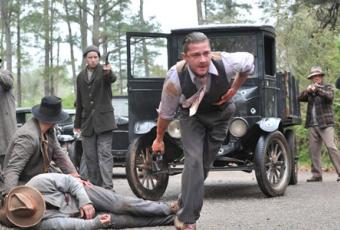
A solid piece of film making that marks its director's most commercial outing to date, Lawless may not wind up a major awards contender come year's end, but it does provide an engaging ride through bootlegging in the Prohibition Era. Directed by John Hillcoat (The Proposition, The Road) with a nice sense of narrative momentum, this is a sturdy, entertaining, nicely acted film, even though it represents a less original, independent point of view than his previous films. Gone is the harsh poetic tone, replaced by lots of talk and lots of shooting.

Based on the, allegedly, true story of the Bondurant brothers, the film charts their run-ins with a dandified new officer (an eerily commanding Guy Pearce) as they attempt to maintain their bootlegging enterprise in Virginia. The plot is straightforward, yet right from the outset, Hillcoat and his collaborators create a palpable atmosphere and a sense of pacing that keeps things moving, without ever rushing. It may not really dwell on character the way Hillcoat's previous films did, but the characters come across nicely. Shia LaBeouf and Tom Hardy deliver nice work as the film's leads, with LaBeouf proving surprisingly charismatic. The characters may not be strongly fleshed out, but the actors at least inhabit them comfortably. The scene-stealer is easily Pearce, in a broadly played yet still scary-as-hell role. Less successful, through no fault of their own, are the film's two female roles, played by Jessica Chastain and Mia Wasikowska. They're mostly used as objects of potential romantic affection for the men, and little else, although Chastain does get one nice, complicated scene toward the end. From a technical standpoint, everything looks and sounds nice, save for a moment or two where Nick Cave's score comes in far too loud. Not the sort of film that will truly amaze you, but it will hold your attention and remain engaging, even when the epilogue hangs on just a hair too long.

Grade: B

Tuesday, April 24, 2012

Trailer: John Hillcoat's "Lawless"


Now that the Cannes Film Festival lineup for 2012 has been unveiled, the countdown begins to see which competition entries will release trailers and clips first. Near the front of the pack is John Hillcoat's Lawless (formerly known as The Wettest County until Terrence Malick gave up the title from his forthcoming film), which looks like a shot of gangster-ized adrenaline.


With a stellar cast (...and Shia LaBeouf) and a fun setting/subject matter (Depression Era bootleggers), Lawless always held a lot of appeal for me. What really caught my eye, however, was director John Hillcoat, whose two previous films (The Road and The Proposition) were simultaneously elegant and brutal. So, knowing Hillcoat's previous work, I thought I had an idea of how Lawless would look and feel. If the trailer is indication, I'm completely wrong. Lawless looks both talky and fast paced, and marks a major departure from the director's previous work. Granted, part of being an artist is the chance to explore new styles, but I can't help feel that some of Lawless looks a little ordinary, and that we're losing a chance to see what his previous style could have had on this sort of story. Granted, the cast looks to be in fine form, and Gary Oldman and Guy Pearce look like excellent villains, but as much as there is to like here, I can't help but feel that we might be headed for something of a missed opportunity.


Trailer Grade: B-

Thursday, January 12, 2012

From Stage to Screen: "Albert Nobbs" and "War Horse"

My next two viewings from the still-warm body of 2011 both have origins on the stage, yet in terms of style and focus, they couldn't be any more different. One is a character study, the other a sweeping WWI tale. Both have ridden into theaters as possible Oscar contenders, though having seen both, the only thought I can come up with is that both should have stayed stage-bound.

Albert Nobbs:

For a movie about a woman disguised as a man in 19th century Ireland, Rodrigo Garcia's Albert Nobbs feels remarkably free of tension. In a story where, arguably, one of the major points of anxiety should be the protagonist's struggle to maintain her identity, everything from the writing to the approach to the makeup fails to create any sense of societal oppression when it comes to the gender roles under examination. Part of the problem is that waiter-in-disguise Albert Nobbs (Glenn Close, begging so damn hard for that Oscar) finds her cover blown within the film's first half hour...by another woman disguised as a man (Janet McTeer). Worse, it's rather obvious that McTeer's Hubert is a woman, and so the moment when she (quite literally) reveals herself comes as anything but surprising (it is, oddly, somewhat funny). But because there's no sense of tension, the film's entire premise fails to generate much interest. Garcia keeps the plot moving at a solid enough pace, but the whole affair has a vaguely sleepy feel to it. When I saw a scene of Nobbs and his/her co-workers eating together, I was immediately reminded of Downton Abbey, and how I wish I was watching that instead. Close is perfectly fine in the role, but the screenplay (which she co-wrote) doesn't do enough with the premise to create a real arc. By the time it rolls into its conclusion, nothing feels surprising or meaningful, and the last minute attempt to turn Nobbs' employer into a passive villain feels unbearably lazy. McTeer is also solid, the film's highlight, although that's not saying much. Less successful is Mia Wasikowska, who is competent throughout, only to completely crash and burn in what should have been her big moment. Worse than any individual, however, is a ludicrous scene at a beach that is almost worth seeing for the unintentional laughs it provokes. In some ways, though, the scene's massive misfire is almost the best part of Albert Nobbs, because it inspires the strongest emotional reaction. Unfortunately, it's completely the wrong one.

Grade: C


War Horse:

They don't make 'em like they used to, although in the case of War Horse, that's probably a good thing. Spielberg's latest, an adaptation of the Tony-winning play of the same name, feels outdated before it can properly get the story moving, and it never recovers. The driving reason to see the stage version of the show was the incredible puppetry. Here, obviously, no such puppets exist, and the crushing banality of the text only becomes more obvious. There's not a shred of character development in any sense, leaving us with an ensemble of empty shells and clichés. The drunken dad! The evil landlord! The brave soldier! The initially discouraging mother! The sick French girl! The old guy! None of it registers, because it's all so paper thin and so obvious in its attempts at sentimentality. So even though the film opens with sweeping landscape shots and features several WWI battles, it never once earns the overwrought strains of John Williams' score. And by the time it arrives at its ending, which I have a hard time describing, War Horse cements itself as a parody of a Spielberg movie, even though it's directed by the man himself.

Grade: C-

Thursday, March 31, 2011

Opposite ends of the spectrum: "Jane Eyre" and "Sucker Punch"

After several failed attempts to make it to the theater (please stay in Boston one more week, Of Gods and Men, I'm on my way), I managed to sneak in two viewings, and they were different, to put it mildly. One was an adaptation of a classic novel, and the other quickly revealed itself to be the wet dream of a 13 year-old anime/video game love trapped in a man's (and director's) body.

**I've also fallen woefully behind on the 30 Day Movie Challenge. Expect a massive catch-up post by the end of the week.

Jane Eyre - dir. Cary Fukunaga:

A brief disclaimer: I haven't yet read Bronte's classic novel. However, whether or not Fukunaga's film (from Moira Buffini's script) is faithful or not, the director's second film is a moody success, if a bit on the minor side. Opening somewhere in the middle of the story, we meet Jane (Mia Wasikowska) straggling across an empty, rainy English landscape. And from these opening moments, Fukunaga establishes his "bold new vision" (quoth the trailer) of Bronte's classic, and it really works. The first shot of Jane is practically a silhouette, appropriate considering how much of the color is infused in the sets and costumes. Fukunaga's film is sparse and generally un-romanticized, yet feels complete and quietly captivating.

And even though it's obvious that some sections of the novel have been trimmed or cut altogether, there's a steady, constantly engaging feeling that arises from the unhurried pace. Key to all of this, of course, is Ms. Eyre herself. Having successfully launched herself into the American conscience in Tim Burton's Eyesore in Wonderland 3D, Ms. Wasikowska is actually able to show off her capabilities as a leading lady here, and she does so with understated skill. I can't speak to whether or not she lives up to previous cinematic Jane Eyres, but she's certainly a damn good one, and her ability to communicate so much in the nuances of her performance, rather than through histrionics, is one of the film's greatest strengths. Matching her is Michael Fassbender as the conflicted Rochester, with whom Ms. Wasikowska has surprising chemistry. A conversation after Jane saves Rochester from small fire in his room, shot almost entirely in shadows, achieves a spectacular level of intrigue and hinted romance that is darker and sexier than anything Megan Fox (or her interchangeable counterparts) has ever done on screen.

Fukunaga's film also benefits from a roster of smaller roles (Jamie Bell, Sally Hawkins, Judi Dench), striking cinematography, and a delicate and dark score from Dario Marianelli (Pride and Prejudice, Atonement). However, despite its strengths, there are a few unfortunate missteps that even someone who hasn't read the book will be able to see. While Fukunaga's choice to open in the middle of the story works, when he returns to that point in the story, he lingers for too long, repeating too much footage as if he wanted to reach a specified run time by any means necessary. And in trimming down Bronte's work, certain scenes and character developments come across as too quick. When Mrs. Fairfax (Dench) mentions that Jane has been working at Rochester's mansion for three months, the revelation comes as surprise, as there's nothing resembling a transition to give us a feel for the passage of time. Similar events populate the rest of the film, to minor detriment. Yet while it isn't a masterpiece, or the new definitive silver screen "Jane Eyre," Fukunaga's second film establishes him as a diverse and daring director, one whose strengths far outweigh his shortcomings.

Grade: B/B+


Sucker Punch - dir. Zack Snyder:
I said that the two films in the post were on opposite ends of the spectrum. However, now it's time to see how extreme their opposition is. Having won legions of fans and haters with his first two films (300 and Watchmen), Mr. Snyder's latest film (his first non-adaptation) will likely only increase the passion with which people love or hate his work. Co-writing and producing an entirely Snyder-riffic vision, Sucker Punch can best be described as a CGI-flooded, faux-feminist clusterfuck of epic proportions.

It opens with surprising strength, in a silent intro/set-up as we meet Baby Doll (Emily Browning). After her mother dies and leaves her everything in her will, Baby Doll faces the wrath of her evil stepfather, who tries to rape her younger sister. After unsuccessfully shooting him (and killing her sister), Baby Doll is put in an insane asylum, where the head doctor is paid off to give her a lobotomy. While there, she meets a group of other girls, also wrongfully locked up, and they set out to escape. Kind of.

In a truly pointless bit of plot design that only serves to muddle the plot, Snyder inserts a second level of reality, before jumping off to his fantastical action set pieces. Here, the asylum is a front for a dance hall, where the inmates are made to perform erotic dances for wealthy male patrons. However, when Baby Doll dances (which we never see, because that would be sexist...unlike all of those shots of Baby Doll's legs and panties...), she imagines herself in a series of battle scenes. Translation, she's imagining herself imagining other things. This alone is enough to make Sucker Punch structurally non-sensical, and things don't pick up from there. The action scenes have their moments, but since we know it's all imaginary, there's no weight to any of what happens. It's just stuff. Really flashy, pixelated stuff. Granted, small moments of violence work, but without anything in the story or character departments to act as support, Snyder's fantasy collapses in on itself.

As for the cast, there isn't really much to it acting wise, although Abbie Cornish and Jena Malone try their hardest (a movie entirely about the two of them would have been much stronger). Browning, the film's lead, however, is something of a blank, while Jamie Cheung and Vanessa Hudgens smile, look worried, or cry while Oscar Isaac goes horribly over-the-top as the villainous Blue and Carla Gugino prances around delivering every line with a campy Polish accent. Jon Hamm shows up for no more than 2 minutes tops, projecting cool but getting absolutely nothing to do. Jon Hamm is a valuable resource, Mr. Snyder, please don't waste him. But worst of all is simply Snyder's insistence that this is something "deep" and empowering for women. That description couldn't be further from the truth. What's really here is the ultimate cinematic wet dream for fans of anime and/or video games who will likely continue to have to pay to be in the presence of beautiful women throughout their lives.

Grade: C-/D+

Tuesday, November 9, 2010

"Jane Eyre" (2011) Trailer


Certainly a bit darker and "thriller-ish" than I would have expected. Embarrassing admission time, though: I haven't read Charlotte Bronte's classic novel, so I can't really comment on what I think of the look in regards to the source material, or whether the actors seem to fit their parts. But overall, there seems to be an extremely gloomy air to this, with little gothic touches that make it feel like a camp-free cousin to Tim Burton's Sleepy Hollow. Whether the March release date is a sign of bad things to come or not, this trailer doesn't exactly have me sold, even though I like everyone involved.

Monday, November 8, 2010

First poster for "Jane Eyre" (2011)


The first poster for Cary Fukunaga's Jane Eyre, and it's surprisingly simple (in a good way). The film is a big departure in terms of subject matter from Fukunaga's last film, the immigration thriller Sin Nombre. One of the great things about having so many adaptations of works like Bronte's is that there are so many different ways directors and actors can impact the way the story is told, and Fukunaga could prove a surprising fit for the material. The film is also notable for its casting, namely Mia Wasikowska as the titular Jane. Wasikowska has been slowly making herself a name in the States, starting with a role on the first season of In Treatment, and then moving on to Alice in Wonderland earlier this year, which made bucket loads but did little to advance her status as an actress. Then came The Kids Are All Right, in which she actually got a chance to act, despite being overshadowed by her adult cast members. Should the film play well, it could be the big critical break that Wasikowska has been looking for, even if it is coming out in the dreaded month of March. Along for the ride are reliable actors Judi Dench, Jaime Bell (Billy Elliot), Michael Fassbender (Inglourious Basterds, Hunger), and Sally Hawkins (Happy-Go-Lucky).

**Actually, it kind of reminds me of the first poster for Blue Valentine, certainly not a bad thing.

Monday, August 2, 2010

"The Kids Are All Right" - REVIEW


I'm having a little trouble processing my thoughts on The Kids Are All Right, not because it's some headache-inducing story or thematic puzzler, but because after all of the acclaim, it just struck me as, well, alright. Well, no, it's significantly above "alright," but it's not the masterpiece some have hailed it as since Sundance. Lisa Cholodenko's exploration of family values in relationships has its shining moments of humor and drama, and its buoyed by work from its cast that ranges from "nice" to "great". The biggest problem, of the two big concerns that I have, is simply that Cholodenko's script feels like a surprisingly good first draft that still has to undergo a fair bit of polishing when it comes to execution.

Nic and Jules (Annette Benning and Julianne Moore - Oscar, please take note), a couple in California, get a bit of a surprise when their two kids (Mia Wasikowska and Josh Hutcherson) track down the sperm donor who made their existence possible. That donor is Paul (Mark Ruffalo), and his involvement (specifically, the fact that both kids want to see him again after their first meeting) is what drives Cholodenko's film. Now, before I start sounding like a nitpicker with a grudge, let me say that I found Cholodenko's presentation of the lesbian family refreshing. This is not a political "issues" movie by any means; it's a matter of fact look at the fact that gay couples with children *gasp* exist and they go through the same highs and lows as everyone else (much like TV's Modern Family). For that, Cholodenko deserves praise. She never condescends to her audience, nor does she go out of her way to make her point. Leading the way (though the emphasis does seem to shift several times) are Benning and Moore, who turn in poignant, heartfelt performances as a normal couple suddenly caught up in an unexpected situation they hoped never to face. I won't play the "who's better" game, as that feels unfair; like Nic and Jules, Benning and Moore balance each other out, even though this results in a few clashes.

And like any normal family, the parents have both chemistry and discordance with their children. Wasikowska, who headlined the unfortunately flat Alice in Wonderland, actually gets to show what she's made of here, and radiates a quiet charm and likability. Hutcherson, unfortunately, is saddled with the less exposed role (for much of the second half he seems to be "there" and not much else), but he shows promise in what he's given. Ruffalo, initially grating, quickly settles into his role, even though it doesn't feel as well defined as the other four characters. In addition to the performances, the soundtrack and Carter Burwell's gentle music add energy to this well edited film.

But like Nic and Jules' family, Cholodenko's film has a few issues that need fixing. In addition to the aforementioned lack of polish (and why does it look slightly dingy on screen in comparison to the trailer?) in the script, there's the climax of Ruffalo's character arc. While I understand it, it does seem a bit frosty and slightly unfair considering the initial forgiveness given to another character. But maybe that's the point, family is family no matter what, and no matter how crucial Ruffalo's role, he'll never be family. Thankfully the film doesn't end there, with the full ending being a much more complete, satisfying one, but the treatment of Ruffalo's character seems a bit much, even considering what happens. Cholodenko's film may treat one character in a questionable manner, but she still treats her audience fairly and the film that unfolds is an insightful look at the ways families are both changing and remaining the same. And, like any family, the film is a little rough around the edges, but at the end of the day, maybe that's alright too.

Grade: B/B+