Showing posts with label Coen Brothers. Show all posts

Thursday, November 21, 2013

Review: "Inside Llewyn Davis"


Director(s): Joel and Ethan Coen
Runtime: 105 minutes

Though undoubtedly a small movie, it would be a mistake to dismiss Inside Llewyn Davis, Joel and Ethan Coen's folk music character study, as a forgettable or minor work in their careers. Firmly anchored by Oscar Isaac's lead performance, this melancholy story is filled with typical Coen quirks, yet ventures into a level of sincerity the brothers rarely tackle. Bound to deepen upon reflection and/or repeated viewings, this deceptively small movie makes its mark thanks to its gently played undercurrent of resilience in the face of sadness.

The titular Llewyn Davis (Isaac) likely won't go down as one of the Coen's more likable protagonists. Though certainly no villain, Llewyn is a great deal less sympathetic than the brother's last lead, True Grit's Mattie Ross. Though he's far from old, Llewyn carries himself like a man who's already been pushed to wit's end (this is nicely complimented by Bruno Delbonnel's blue-hued, wintery images). When we first meet him, Llewyn is singing his heart out into a microphone, and for a while it looks like he's performing in a vacuum as he pours out his soul. As the scene pulls back, however, we see that all of Llewyn's passion is being put forth in a dingy bar, with an audience that is appreciative and engaged, but not exactly enraptured. Llewyn's doing his best to communicate the only way he really knows how, but the gulf between artist and audience is quite a large one.

If Llewyn's interaction with his audience is lacking, his ability to interact with friends and family is even more dire. There are friends like Jim (Justin Timberlake) and Mitch (Ethan Phillips), but they seem like distance acquaintances at best (although not too distant that Llewyn won't abuse their hospitality). Then there are people like Jim's wife Jean (Carey Mulligan), who rightfully has nothing but contempt for Llewyn or anything he stands for. Through a series of tautly written, intelligently acted scenes, the Coens establish a whole host of relationships from Llewyn's POV, thus firmly planting him in his head. We spend time viewing events from his perspective, even as the direction is wise enough to avoid siding with Llewyn's thoughts and actions.

The surprisingly fleet pacing, with conversations often ending with hard cuts to a new shot, is what gives Inside Llewyn Davis a defiant lack of heaviness. The Coens aren't interested in misery porn or yanking at heart strings. Though the story's setting and music make it ripe for noxious sentimentality, the directors never betray their own level of emotional restraint, even as they branch into more sincere territory. Rather than blast emotions at the viewer, the film mostly underplays things - events, backstories, details - thus allowing them room to reverberate with the viewer throughout (and after) the whole film. 

For all that there is to say about the writing and directing, it would be foolish as well to say that the film isn't an actors' piece of sorts. Isaac, in his first real leading role, is nothing short of outstanding, whether he's singing, arguing, or merely observing and laying low. Isaac's turn is so key to the film, that whether or not you respond to it will likely come down to how to connect (or don't) to the actor's approach to him, as well as the film's. 

Supporting roles, meanwhile, often feel like hazily sketched satellites orbiting Llewyn's life. This is true of some (Jim and Mitch, Mitch's wife), but in characters like Jean the film is able to communicate so much with so little. In large part, that's due to what Mulligan pulls off, starting with bigger, noisier scenes before quieting down and hinting at a fuller, more authentic personality. Even F. Murray Abraham, who only appears in one scene, gives a performance that feels lived in. It's just not his life that we as a viewer are oriented around. 

The most valuable supporting player, however, is the music. Though little (if any) is original, music supervisor T. Bone Burnett (along with Isaac) has done a beautiful job of compiling a series of songs that work perfectly in sync with the story. It's hard to imagine swapping any songs in terms of order, given how carefully they've been positioned throughout the film. Details like this emphasize what makes Inside Llewyn Davis so special, despite its narrative and emotional modesty. 

The level of care present in every scene and shot may not always be immediately apparent, but the film moves in ways that have a confident sense of purpose. Llewyn hops from place to place, and the film hops from scene to scene, yet no excursion is without purpose. Inside Llewyn Davis is undoubtedly a small film, but it's anything but minor. It's an understated dark comedy handled with unparalleled restraint, which is precisely why it's so deeply felt. 

Grade: A-

Monday, June 25, 2012

The Netflix Files: June 18-24


 Louie Season 1 (2010) created by Louis C.K.

Seeing as Louie is often described as the "actual" best comedy on TV, I jumped at the chance to give it a go when it showed up online, seeing as the new season was right around the corner.  With shows like these - based on a comedian's life/stand up material - one has to be open to a very distinctive point of view, which often presents some type of adjustment curve. With Louie, however, the adjustment curve lasted a long time (essentially the whole season), and at the end I still wasn't sure I was a fan, let alone a believer that this was the best show on TV. Mining humor out of awkward situations is nothing new at this point, but C.K. seems to revel in a certain blend of ugly unpleasantness and direct social commentary that often feels forced and unfunny. Comedies with darker sides are, likewise, not novelties, but Louie goes too far with it at times, being too dour, unpleasant, and/or gross for its own good, often suffocating the humor in order to make some sort of point.


Grade: C+/C


Louie Season 2 (2011) created by Louis C.K.

If the first season of Louie was a major disappointment, then consider season two the show's redemption. While the problems of season one are still present, the humor comes through so much more, and the bitterness and melancholy often feel earned. The episode structure remains the same (and is surprisingly limited, consisting usually of two separate sequences that never go very far) but the results are so much stronger. The mid-season episode "Subway; Pamela," the series' shining moment so far, is the best example, providing moments of hilarity, absurdity, and just the right touch of sadness, courtesy of C.K.'s relationship with fellow single parent Pamela (Pamela Adlon). And, where season one ended and left me seriously debating whether I wanted to continue with the show, season two's wonderful conclusion has left me eager for the start of season three this Thursday.


Grade: B/B+


Raise the Red Lantern (1991) dir. Zhang Yimou

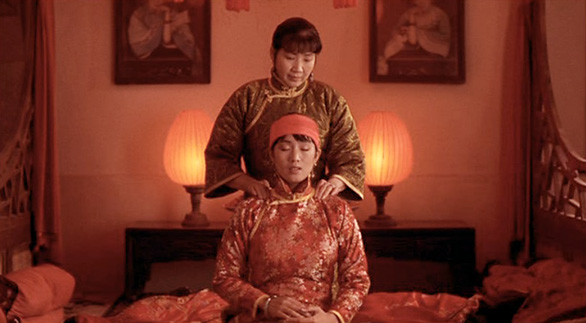
Before Zhang Yimou began making wildly colorful fantasies (Hero, House of Flying Daggers), he made his mark on global cinema with this lush, restrained look at family relationships in 1920s China. After her father's death, Songlian (the seemingly ageless Gong Li) is married to a wealthy man, becoming his fourth (simultaneous) wife, and competes for his attention and affection with the man's three other brides. The material certainly has some operatic overtones, but Zimou and the cast manage to execute the story, set entirely within the rooms and walls of the husband's stone compound, with a level of dignity (and even coldness) that prevents it from devolving into melodramatic nonsense. Performances all around are strong, and it's easy to see why Li's career quickly exploded after the film's debut. A slow, but sumptuous and ultimately affecting drama that has held up well. 


Grade: B+


The Man Who Wasn't There (2001) dir. Joel Coen

One of the Coen brothers' lesser discussed efforts, this foray into noir proves to be surprisingly engaging and enjoyable. The plot hits many familiar beats (a man blackmails his wife and her lover until things spiral out of control), but the screenplay navigates the territory so as to make it feel fresh. Billy Bob Thorton, in the central role, is used to strong effect as Ed, a low-key, quiet figure who finds himself in escalating circumstances. The supporting cast is great as well, filled with nice turns from Frances McDormand, James Gandolfini, Tony Shaloub, and Katherine Borowitz, who delivers the film's best performance in a single riveting (and bizarre) conversation with Thorton. Despite the Coens' tendencies to wink at the audience, the film does play well as a straight noir despite one bit of out-there plotting (it's too good to spoil) and a smart jab at the verbosity of noir voice over narration. It may not get the recognition it deserves, but this strongly acted and immaculately designed film (thank you again, Roger Deakins/Dennis Gassner/Mary Zophres/etc...) is a true gem in the already jewel-encrusted crown that is Joel and Ethan Coen's career.


Grade: B+/A-

Thursday, December 23, 2010

"True Grit" - REVIEW


Mattie Ross (Hailee Steinfeld) repeatedly announces that she is "only 14 years old," and unlike the original True Grit, which starred a 20-year-old Kim Darby as Mattie, when Steinfeld says it, it rings true. Only 13 when she shot the latest film from Joel and Ethan Coen, Steinfeld's role is much more important than it was in the 1969 original, and it's just one of the reasons why the Coens' remake (or rather, re-adaptation) works so well.

Like the original, True Grit tells the story of a Mattie Ross' attempt to track down her father's murderer by hiring a hard-nosed US Marshall named Rooster Cogburn. Now, as to just how close the Coens stuck to Charles Portiss' novel for their screenplay, I can't vouch, as I've never read the source material. That said, in going back to the text instead of the John Wayne film, they've found a way to make a film that is much more inline with their sensibilities, and even their sense of humor. This is a good thing, because if there's one thing that surprised me in True Grit, it's the amount of humor that runs almost consistently throughout the film.

And even though the humor (and the story) may not entirely have the typical Coen brothers sense of irony, it still feels as though something they would come up with if they felt like playing it a little on the safe side. Assisting them through these (relatively) tame waters is their impeccable cast. Though she's been placed in (and won) supporting actress in the critics awards thus far, Steinfeld truly deserves to be labeled as lead. Cogburn (Jeff Bridges) may be the iconic character from Portiss' story, but at heart the story belongs to Mattie and her quest for justice and vengeance. Steinfeld beautifully captures the sense that Mattie is both a girl mature beyond her years, and yet still, well, 14 years old. As for Bridges, the role remains something of an emblem rather than a fully-formed character. What background details we're given don't really sink in, as their used more to portray Cogburn as a man with a penchant for rambling. That said, Bridges, whose last collaboration with the Coens gave us the ultimate laid-back "Dude," is able to pull off the role, one which has such large boots to fill. But the real joy of the film (aside from the surprise of Steinfeld) is Matt Damon as Texas Ranger LeBeouf, who has been searching for Tom Chaney (Josh Brolin) for a separate crime. Damon, recently returning to comedy on NBC's 30Rock, gets to show off his comedic talents even more here, and he plays the slightly huffy, self-important Ranger with just the right touches, without making the character truly obnoxious or unbearable. A good part of the fun also comes from the fantastic (if at times overly wordy) dialogue, which is a mix of wild west gruffness mixed with a strange pseudo-Shakespearean tone (don't expect many contractions).

But good performances are nothing new for the Coen brothers. What's really, really surprising is the film's overall emotional impact. In a career long-dominated by black humor, irony, and in some cases flat out nihilism, True Grit ends up being surprisingly touching. I can't remember the last time that term applied to anything the Coens have done (if ever). Even with the comedic aspects of the film penetrating further into the story that one would expect, by the time it reaches its climax and begins to wind down, the result is actually moving (though completely free of schmaltz). While the story basics and characters may have been traversed before, for the Coens, True Grit is bold new territory well-explored.

Grade: B/B+

Monday, October 4, 2010

Full-length "True Grit" trailer


A much different, yet equally thrilling direction. I love getting to hear more of the dialogue, and it's always a plus getting to see more of Roger Deakins' cinematography. This looks tough, brutal, and brilliant. The only thing that seems off is Matt Damon's make-up; that facial hair seems weird on his face somehow. Still, the cast looks great, and the more I see of Hailee Stanfield, the more impressed I am with her. If anyone could take a classic, star-vehicle western and potentially create a great remake, it's the Coen brothers, and this looks like one hell of a Christmas present. Great use of that Johnny Cash song too, by the way.

Tuesday, September 28, 2010

"True Grit" trailer (watch it while you can!)


This looks pretty fantastic. Aside from the obviously stunning cinematography from Roger Deakins (maybe he can finally get that Oscar this year?), the film reminds me of a quote I read about the brilliant No Country for Old Men, where the writer described the film as the first time the Coens "treated their characters without a wink." The same seems to be true here; none of the cruel ironies of A Serious Man or Burn After Reading. And since the Coens' last effort like this turned out so well, I have great faith in this film.